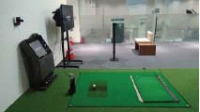
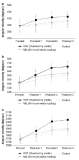
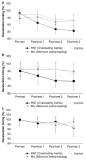
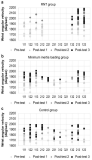
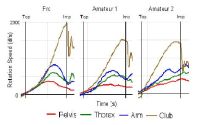
[Purpose] We examined the influence of reactive neuromuscular training (RNT) on golf swing coordination. RNT aims to induce proper coordinative movement by exaggerating the performer’s mistakes. Therefore, we applied RNT using inertia overloading to golfers who have problems with kinematic sequence during a golf swing. [Methods] To examine the effect of 12 weeks of RNT on golf swing coordination, we employed a ball tracking system (launch monitor) and motion analysis system (inertia sensors) were taken on four consecutive periods (pre-test and post-tests 4, 8, and 13 weeks later). Thirty Korean male cadets were divided into three groups based on inertial loading and practiced 7-iron golf swings combined with specific group tasks twice per week. [Results] At pre-test, most participants reached maximal angular velocity near the impact timing (95-100%). However, the deceleration timing of the maximum angular velocity of the proximal segments gradually moved toward mid-downswing as the training sessions proceeded, with the RNT group ultimately outperforming the two control groups. Additionally, the RNT group showed a significantly higher maximum angular velocity in the thorax and wrist. [Conclusion] Our results suggest that RNT can be sufficient to elicit and effective whole-body coordination pattern. Considerable follow-up research is needed on the use of RNT for various sports tasks and the effects of expertise on RNT results.
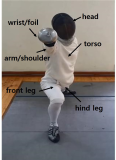
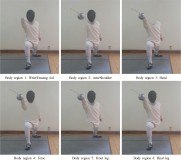
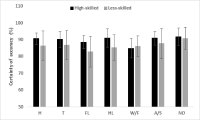
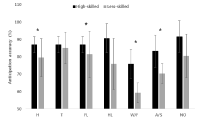
Purpose The purpose of this study was to establish the differences of anticipating accuracy and confidence according to fencing expertise and spatial occlusion region. Methods For the purpose of this study, the anticipation ability of 6 high-level fencing players and 6 low-level fencing players were analyzed. All subjects performed the 60 tasks of anticipating the attack positions(thorax, thigh, toe) from observing the fencing video screen using spatial occlusion technique. The spatial occlusion technique was used in 6 particular body of opponent’s movement. For statistic analysis, data was analyzed through independent T-test measure. Moreover, Paired t-test were used as follow-up analysis. Results The results of the study were as follows: In terms of accuracy anticipation, the main effect of expertise was significantly different. Specifically, when the spatial occlusion technique was applied in head, left leg, arm, and a foil, the accuracy of anticipation was significantly different. Moreover, comparing with no-occlusion condition, anticipation accuracy decreased when spatial occlusion technique was applied in arm and foil. In terms of confidence, there was no significant difference between level of expertise. Conclusions In order to effectively anticipate the opponent’s movement in fencing sports, it is necessary to focus on the visual cues of arm/shoulder, and the foil. Especially, focusing on the foil movement might provide the core informations on anticipation ability.