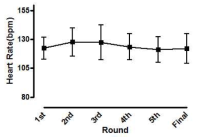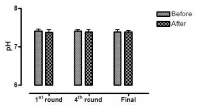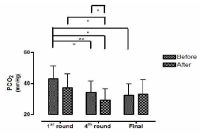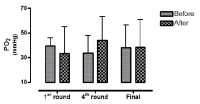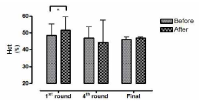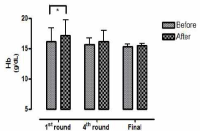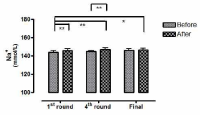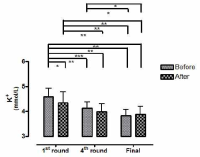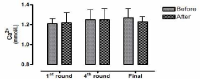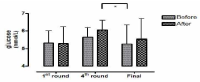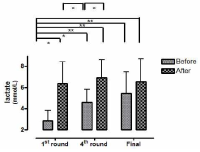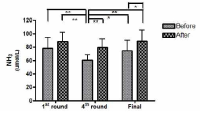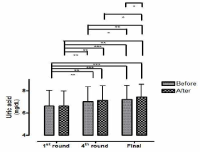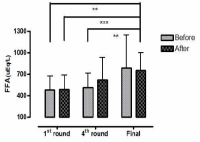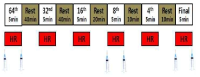
This study aimed to examine the change of the indices in blood gas, ions, and by-products of fatigue substances and components in collegiate elite Kumdo competitors, who carry out a number of competitive games during one day tournament event. Subjects were carried out total 6 simulated, but followed same conditions and rules of actual competition, with providing similar inter-game break time. Eight well trained male competitors, who had awarded from national wide competitions, voluntarily participated in this study and revealed 51.5(±8.8) mL·kg-1min-1 of maximal oxygen consumption and 12.4(±5.1) % body fat. TWOWAY ANOVA (tournament round vs. pre & post each game) was adopted to test whether the mean differences were existed, and the interaction between individual factors and main effect within each factors were analyzed. Statistical significance was set at Alpha (α) = .05. While there were no significant changes in blood hydrogen ion concentration (i.e., pH) and partial pressure of oxygen (PO2), partial pressure of carbon dioxide (PCO2) significantly decreased as the tournament games were repeated. The level of hemoglobin and hematocrit were significantly elevated only during the 1st round of tournament. Na+ was significantly increased but K+ was decreased. Ca2+ concentration however, was not significantly altered. Although the changes of blood glucose level did not show any consistent patterns, free fatty acid (FFA) concentration was increased after completed each game compared to prior to initiate the each game. Blood NH3, lactic acid, and uric acid concentration increased at immediately after each game, and the pattern was maintained throughout the tournament round continued. These results reflected that the repeated participation of the tournament may cause the accumulation of the by-products of fatigue substances in blood and alteration of various ion components and energy substrates. Accordingly, the ways of reducing the physical fatigue and providing adequate energy source inter-tournament games needs to be necessarily considered for successful Kumdo competition. Data obtained from this study could valuable for searching the effective training and management methods to improve the performance and reduce the fatigue of the professional elite Kumdo competitors.