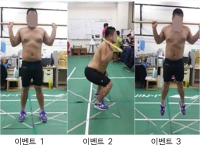
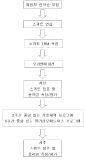
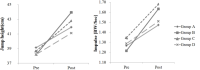
The purpose of this study was to find which percentage of 1RM for squat to improve the result of squat jump most effectively after plyometric training with different percentage of 1RM for squat. 24 men in their twenties were measured 1RM for squat and separated in 4 groups by 6 participants. Group A, B, C, and D used 0, 15, 30, and 45% of 1RM, respectively in the plyometric training. All groups had 1 hour training 3 days per week for 8 weeks(24 sessions). This study designed to increase the number of sets of exercises gradually. In week 1 and 2, participants trained 1 set of plyometrics with no load. The number of sets increased 2 to 4 in the week 3-4 to 7-8. The jump height(cm) and vertical impulse(%BW) of squat jump before and after plyometric training were measured by 3D motion capture system and force plate. All 4 groups showed the improvement of squat jump height and vertical impulse, but specially group B was most improved(p<0.5).