Impact of 9-week strength training of racing cyclist candidate during training camp on body composition, racing cyclist specific fitness, and racing cycle performance was examined. Two by two (cyclist experience, y/n and strength training (ST) participation, y/n) experiment design was employed. A total of 20 candidates participated and divided evenly into four groups; 1) experienced cyclist participating ST (CST), 2) non-experience cyclist participating ST (nCST), 3) experienced cyclist no participating ST (CnST), and 4) non-experience cyclist no participating ST (nCnST). Two programs were introduced; 1) non ST containing, pre-existing program emphasizing on sprint and acceleration training and 2) new-program containing ST and sprint and acceleration training. CST and nCST participated the latter program. Before and after the 9-week training, body composition, racing cyclist specific fitness, and racing cycle performance was tested. After 9 weeks, all groups decreased body weight(p<0.05), body fat content(p<0.05), body mass index, and CST and nCST increased lean body mass(p<0.05). Muscular strength measures such as grip strength, low back strength, 1RM of bench press, 1RM of squat, and anaerobic capacity improved after 9 weeks in all groups(p<0.05). The magnitude of changes was greater in order of CST, nCST, CnST, nCnST. Time trial of 200 meter sprint was faster after 9 weeks in all groups except CnST while 500 meter sprint was improved only in nCnST(p<0.05). After 9 weeks, regardless of previous cyclist experience, those who participated in ST ranked high places at racing cycle competition. Both training programs for the candidates improved body composition and racing cyclist specific fitness. When strength training was added to pre-existing training program emphasized on sprint and acceleration, the racing cycle performance was enhanced. Strength training for racing cyclist is highly recommended to improve their racing performance.
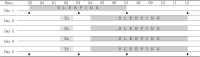
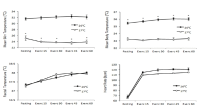
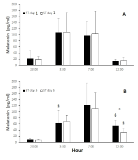
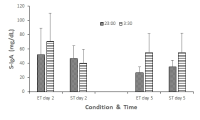
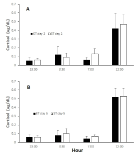
Whether a nocturnal exercise with concomitant increase of body temperature (Tb) would intensify circadian phase delay compare to exercise with a suppressed Tb increase was examined. Seven healthy men (20.57 ± 2.88 yrs, 174.43 ± 4.05 cm, 70.13 ± 6.07 kg, 10.74 ± 1.92% fat) participated in two tests. Each lasted 5-days. On the day of 1 of each test, subjects maintained habitual sleep time (23:00-07:00, 0.2 lux) in laboratory. From day 2 thru 5, they biked for 60 min at 55% of maximal capacity beginning at 01:30 (15 lux). Then they went to bed at 04:00 and woke at 12:00. During test, they exercised either at 26℃ with elevating Tb (ET) or at 17℃ with cooling devices for suppressing Tb (ST). Two tests were counter balanced and separated by 2 weeks. During exercise, rectal (Tre) and skin (Tsk) temperatures, and heart rate were continuously recorded. Body weight changes during exercise were measured. Urine volume and saliva sample were collected. Blood samples were taken at 23:00, 03:30, 07:00, and 12:00 on day 1 and 5 of tests and analyzed for melatonin. The average weight loss for 4 days of exercise in ET and ST was 0.62 ± 0.09 and 0.22 ± 0.07 kg, respectively (p<.001). Tre increased during exercise but not different between conditions. Tsk maintained at 32℃ in ET and 24℃ in ST (p<.001). Tb were higher in ET than ST during exercise (p<.05). The average total urine volume passed was 0.07 ± 0.07 in ET and 0.11 ± 0.07 liter in ST (p<.05). The melatonin concentration at day 1 was 23 ± 26, 107 ± 45, 98 ± 46, and 14 ± 5 in ET and 18 ± 10, 108 ± 65, 103 ± 75, and 14 ± 12 pg/ml in ST for each time period. At day 5, it was 9 ± 3, 64 ± 41, 122 ± 73, and 54.1 ± 17.8 in ET and 8 ± 1, 68 ± 21, 111 ± 52, and 32 ± 14 pg/ml in ST. Differences of melatonin between ET and ST at day 5 of 12:00 as well as between day 1 and 5 at 12:00 of both conditions were noticed (p<.05). Salivary cortisol and immunoglobulin-A were not different. A nocturnal exercise induced a circadian phase delay in both conditions. However, body temperature increase during exercise intensified the shift indicating the importance of thermal load during exercise for circadian shift.