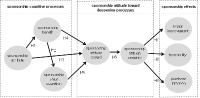
Purpose The purpose of this study was to examine the relationships among sponsorship attributes, sponsorship benefits, recognition of sponsorship value, sponsorship attitude, and sponsorship certainty through structural equation model. Methods Respondents were university students living in Seoul, Kyoungki-do, and choongchung-do. The present study was designed to identify the effect of title sport sponsorship by utilizing NH V-LEAGUE title sponsorship. By using convenience sampling method, total 400 questionnaires were distributed and gathered from samples, and among them 369 valid samples were used for further analyses. The data were recorded and analyzed using the IBM SPSSWIN Ver. 21.0 and AMOS 18.0. 18.0. Results First, sponsorship attributes had a positive influence on sponsorship benefits. Second, sponsorship benefits had a positive influence on sponsorship value recognition. Third, sponsorship attributes had no positive influence on sponsorship attitude. Fourth, sponsorship benefits had a positive influence on sponsorship attitude. Fifth, sponsorship value recognition had a positive influence on sponsorship attitude. Sixth, sponsorship attitude had a positive influence on sponsorship attitude certainty. Seventh, sponsorship certainty had a positive influence on sponsorship effects (image improvement, favorability, purchase intention).

Purpose The purpose of this study is to empirically inquire into the relationship between a commercial sports center employee's humor orientation & customer orientation and employees' trust, service quality, sports center relationship quality and relationship retention through structural equation model analysis. Methods For this purpose, the survey targeted 224 adult men and women who have used any one of the three commercial sports centers in Chungcheong for over three months. For sampling method, convenience sampling method was used, while the questionnaire was self-administered. In an effort to verify the proposed structural model, this study used IBM SPSSWIN Ver. 21.0 and AMOS 18.0. Results First, humor orientation was found to have a positive influence on employees' trust. Second, customer orientation was found to have a positive influence on employees' trust. Third, employees' trust was found to have a positive influence on service quality. Fourth, employees' trust was found not to have a positive influence on sports center relationship quality. Fifth, employees' trust was also found not to have a positive influence on relationship retention. Sixth, service quality was found to have a positive influence on sports center relationship quality. Seventh, service quality was also found not to have a positive influence on relationship retention.

Purpose This research was to empirically analyze the relationship between a commercial sports center customer-perceived employees' emotion labor (deep acting, surface acting) and sports center emotion, service quality & relationship retention through structural equation model analysis. Methods For this purpose, this study set 270 members at the two commercial sports centers(facilities equipped with more than 3 events) located in Suwon as the research subjects. In an effort to verify the proposed structural model, this study used SPSSWIN Ver. 21.0 and AMOS 18.0. Results first, this study found that deep acting had a positive effect on positive emotion. Second, it was found that surface acting had a positive effect on negative emotion. Third, deep acting was found to have a positive effect on service quality. Fourth, surface acting was found to have a negative effect on service quality. Fifth, the results showed that positive emotion didn't have a positive effect on relationship retention. Sixth, negative emotion was found to have a negative effect on relationship retention. Seventh, service quality was found to have a positive effect on relationship retention. Conclusion This findings indicate that the management of emotional labor is critical from the aspects of personnel management in sport centers.

Purpose This study was to examine the relationships among title sponsor's social inference(majority exposure, reliability, topicality, & social response), sponsor attitude formation(sponsor attitude, event sponsorship attitude, & communication attitude), and sponsorship effect (sponsor identification, attitudinal loyalty, and behavioral loyalty) in the professional volleyball contexts. Methods A survey was conducted by using college students (n=370) majoring in sport and physical education at four universities located in Chungcheong Province. The data were recorded and analyzed using the SPSSWIN Ver. 21.0 and AMOS 18.0 to analyze the structural equation model. Results First, the increased majority exposure had a significantly negative effect on sponsor attitude. Second, reliability was found to impact significantly on sponsor attitude. Third, topicality was found to impact positively and significantly on sponsor attitude. Fourth, social response did not show significant impact on sponsor attitude. Firth, sponsor attitude was found to significantly influence on event sponsorship attitude. Sixth, sponsor attitude had positive impact on communication attitude. Seventh, event sponsorship attitude was found to impact positively and significantly on sponsor identification. Eighth, communication attitude was found to impact positively and significantly on sponsor identification. Ninth, sponsor identification was found to impact positively and significantly on attitudinal loyalty. Tenth, sponsor identification was found to impact positively and significantly on behavioral loyalty. Finally, attitudinal loyalty was found to impact significantly and positively on behavioral loyalty.
