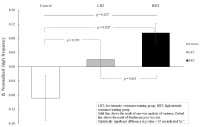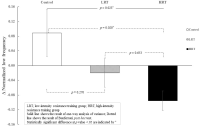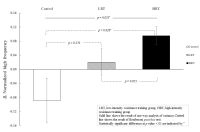
The purpose of this study is to investigate the influence of resistance training with different exercise intensities on heart rate variability(HRV) in habitual smokers. Twenty-eight healthy young smokers participated in this study were randomly divided into three groups; CON(control), LRT(low-intensity resistance training; 50% 1RM), and HRT(high-intensity resistance training; 70%1RM), respectively. LRT and HRT groups performed an 8-week resistance training(4 upper- and lower body exercises) using weight training machines, whereas CON group maintained their regular activities. All groups were evaluated basal body composition, hemodynamic parameters, HRV as autonomic nervous function, and muscular strength (1RM and isokinetic test) before and after the 8-week training. To assess the effect of 8-week training with different intensities on autonomic regulation, time and frequency domain indices of HRV were calculated from 5min R-R interval recording. As results, both LRT and HRT groups increased baseline 1RM and isokinetic strength compared to CON group. Meanwhile, high-frequency power reflecting parasympathetic activity was significantly increased in HRT compared to CON group. In addition, normalized low frequency power(LF nu) indicating a shift of sympathovagal balance towards sympathetic predominance significantly decreased while normalized high frequency power(HF nu) which reflects vagal predominance significantly increased in HRT compared to CON group. Furthermore, improved cardiac autonomic regulation and parasympathetic activation had significant association with increased muscular strength. Overall, the 8-week training has enhanced muscular strength in both training groups, particularly autonomic balance improved in young habitual smokers with high intensity resistance training.