
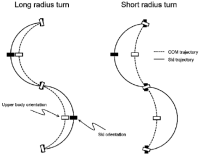
Purpose The purpose of this study was to investigate the three dimensional joint angles of the ankle, knee and hip during basic long turn, carving long turn, basic short turn and carving short turn. Methods Fourteen alpine ski instructors from Korea Ski Instructor Association participated in this study. Each skier asked to perform 4-types of turning technique, classified by radius and level. 8 inertial measurement units were used to measure three-dimensional joint angles of the ankle, knee and hip joint. Results Significant differences were found the lower extremity joint angles on the mediolateral and vertical axis during long-turn and carving-turn (p<.05). significant differences were found the lower extremity joint angles on the anteroposterior axis in the steering phases 1, 2 and complete phase (p<.05). Conclusions In the Alpine skiing, the short turn requires a complex movement of the lower limb joint compared to the long turn. When performing a long turn, the movement of the ankle joint on the vertical axis are required compared to the short turn. And the carving and short turn need to the movements of the lower limb joint on the mediolateral axis.

PURPOSE The purpose of this study was to compare the dynamic postural control of youth athletes with and without a history of lateral ankle sprains. METHODS Twenty-eight youth athletes (14 lateral ankle sprain, 14 healthy control) participated in this study. All participants answered the Foot and Ankle Ability Measure questionnaire and were subject to the Star Excursion Balance Test (SEBT) for dynamic postural control evaluation to collect the joint angles of the lower extremity, a center of pressure (COP) path, and COP velocity. Independent sample t-test or Mann-Whitney U-test were performed to analyze the difference between the groups. RESULTS The lateral ankle sprain group (LAS) was found to have a long experience in participating in sports, and low Foot and Ankle Ability Measure scores were identified when compared to the healthy control (CON; p<0.05). LAS was observed with a short reach distance, less hip flexion, and dorsiflexion angles during the anterior direction of SEBT when compared to CON (p<0.05). Furthermore, LAS showed a slower anteroposterior and mediolateral center of pressure velocities in the posteromedial aspect of SEBT and a slower anteroposterior COP velocity in the posterolateral aspect of SEBT when compared to that of CON (p<0.05). There were no differences between the groups with respect to the other variables (p>0.05). CONCLUSIONS Based on these results, decreased anterior reach distance of SEBT may be affected by changing the dynamic posture control strategy of the lower extremity joint on the sagittal plane in LAS.
