Purpose The purpose of this study was to investigate the effect of auditory stimulus using white noise on stability and balance during sit-to-stand and standing tasks of chronic stroke patients. Methods Eighteen chronic stroke patients participated in this study. They asked to perform the tasks of sit-to-stand, standing with eyes open and standing with eyes closed before and after listening to white noise. Eight infrared cameras and one force plate were used to evaluate the stability and balance before and after the white noise stimulus during each task. Results There was no significant difference between before and after white noise stimulus in all tasks. On the other hand, the anteroposterior range of CoP was significantly decreased after white noise stimulus in standing with eyes-closed (p<.05), and the sagittal angle of CoP-CoM was significantly decreased after white noise stimulus in standing with eyes-open and eyes-closed (p<.05). Conclusion Auditory stimulus using white noise improves the balance of chronic stroke patients. Therefore it is thought to be helpful for the independent daily life of chronic stroke patients.

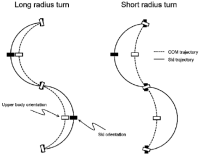
Purpose The purpose of this study was to investigate the three dimensional joint angles of the ankle, knee and hip during basic long turn, carving long turn, basic short turn and carving short turn. Methods Fourteen alpine ski instructors from Korea Ski Instructor Association participated in this study. Each skier asked to perform 4-types of turning technique, classified by radius and level. 8 inertial measurement units were used to measure three-dimensional joint angles of the ankle, knee and hip joint. Results Significant differences were found the lower extremity joint angles on the mediolateral and vertical axis during long-turn and carving-turn (p<.05). significant differences were found the lower extremity joint angles on the anteroposterior axis in the steering phases 1, 2 and complete phase (p<.05). Conclusions In the Alpine skiing, the short turn requires a complex movement of the lower limb joint compared to the long turn. When performing a long turn, the movement of the ankle joint on the vertical axis are required compared to the short turn. And the carving and short turn need to the movements of the lower limb joint on the mediolateral axis.