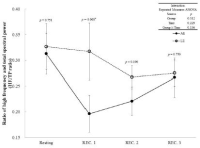
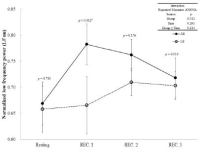
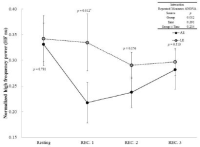
Although delayed heart rate recovery (HRR) and impaired autonomic nerve system (ANS) modulation after acute exercise are related with cause of cardiovascular disease (CVD) and mortality, studies evaluating ANS changes with local exercise are still unsatisfied. Thus, this study aimed at investigating the modulation of ANS-related parameters, followed by upper or lower body exercise. Eleven male without cardiovascular and orthopedic diseases measured basic body composition, resting blood pressure (BP), and heart rate variability (HRV). This study based on randomized cross-over design; AE composed with arm-ergometer, and LE involved with leg cycling. Participants had at least one week wash-out between each exercise, also there was no cool-down after exercise. All sessions were performed with intensity of 50 % target heart rate for 30 min. With measurement of Rating of perceived exertion (RPE) during every 10 min, HRV was measured Kubios HRV software using R-R intervals collected with Polar RS800CX in post-exercise recovery (for 30 min). As a result, heart rate (HR) and RPE were same (p > 0.05) through the experiment. As results of this study, SDNN and rMSSD in time domain on LE were higher than on AE during post-exercise recovery. When LE compared with AE used by Poincare plot, both parasympathetic reactivation (SD1) and autonomic nerve regulation (SD 2) on LE were higher than AE. Immediately after submaximal exercise, the high-frequency component on LE was significantly greater compared to AE. Also, the LF/HF ratio and LF nu reflecting sympathetic activity were higher on AE than LE. In contrast, the HF/TP ratio and HF nu reflecting vagal tone were greater on LE than AE. In conclusion, this study suggested regional lower body exercise recovers more sufficient than regional upper body exercise after submaximal aerobic exercise at same HR. Local exercise like leg cycling needs a careful approach to apply for accurate exercise prescription and effective training.

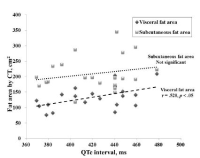
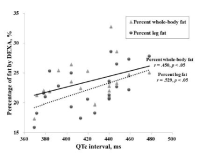
The purpose of this study was to examine the relationship between QTc interval and maximal oxygen consumption(V˙O2max) and body fat distribution in middle-aged men. Abnormal subjects (QTc interval, ≥440ms, n=10) and normal subjects(≤430ms, n=11) using QTc interval based on the Bazzet's equation were involved in the study. After overnight fasting, blood and blood pressure were measured. Abdominal fat area and regional fat compartment were measured by computed tomography(CT) and dual-energy X-ray absorptiometry(DXA), respectively. For V˙O2max, the subjects underwent a maximal graded exercise test on a cycling ergometer. Abnormal group was significantly higher in SBP, basal insulin, HOMA-IR, and leg fat compared with normal. There was a significant relationship(r=.614, p=.03) between QTc interval and V˙O2max in all subjects. Also, partial correlation analysis showed a significant relationship(r=.480, p=.032) between the QTc interval and V˙O2max. Having a QTc interval outside normal range significantly worsened risk parameters for metabolic syndrome, in particular blood pressure and insulin resistance. Moreover, QTc interval was strongly correlated with cardiorespiratory fitness in middle-aged men. This study indicates that further study will be needed to assess the exercise training effects on QTc interval.

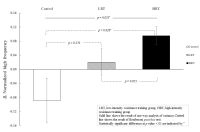
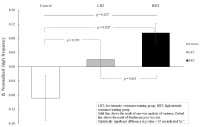
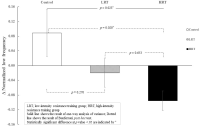
The purpose of this study is to investigate the influence of resistance training with different exercise intensities on heart rate variability(HRV) in habitual smokers. Twenty-eight healthy young smokers participated in this study were randomly divided into three groups; CON(control), LRT(low-intensity resistance training; 50% 1RM), and HRT(high-intensity resistance training; 70%1RM), respectively. LRT and HRT groups performed an 8-week resistance training(4 upper- and lower body exercises) using weight training machines, whereas CON group maintained their regular activities. All groups were evaluated basal body composition, hemodynamic parameters, HRV as autonomic nervous function, and muscular strength (1RM and isokinetic test) before and after the 8-week training. To assess the effect of 8-week training with different intensities on autonomic regulation, time and frequency domain indices of HRV were calculated from 5min R-R interval recording. As results, both LRT and HRT groups increased baseline 1RM and isokinetic strength compared to CON group. Meanwhile, high-frequency power reflecting parasympathetic activity was significantly increased in HRT compared to CON group. In addition, normalized low frequency power(LF nu) indicating a shift of sympathovagal balance towards sympathetic predominance significantly decreased while normalized high frequency power(HF nu) which reflects vagal predominance significantly increased in HRT compared to CON group. Furthermore, improved cardiac autonomic regulation and parasympathetic activation had significant association with increased muscular strength. Overall, the 8-week training has enhanced muscular strength in both training groups, particularly autonomic balance improved in young habitual smokers with high intensity resistance training.