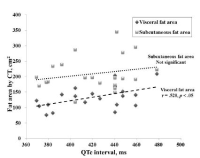
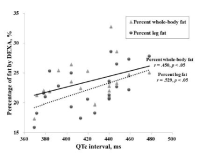
The purpose of this study was to examine the relationship between QTc interval and maximal oxygen consumption(V˙O2max) and body fat distribution in middle-aged men. Abnormal subjects (QTc interval, ≥440ms, n=10) and normal subjects(≤430ms, n=11) using QTc interval based on the Bazzet's equation were involved in the study. After overnight fasting, blood and blood pressure were measured. Abdominal fat area and regional fat compartment were measured by computed tomography(CT) and dual-energy X-ray absorptiometry(DXA), respectively. For V˙O2max, the subjects underwent a maximal graded exercise test on a cycling ergometer. Abnormal group was significantly higher in SBP, basal insulin, HOMA-IR, and leg fat compared with normal. There was a significant relationship(r=.614, p=.03) between QTc interval and V˙O2max in all subjects. Also, partial correlation analysis showed a significant relationship(r=.480, p=.032) between the QTc interval and V˙O2max. Having a QTc interval outside normal range significantly worsened risk parameters for metabolic syndrome, in particular blood pressure and insulin resistance. Moreover, QTc interval was strongly correlated with cardiorespiratory fitness in middle-aged men. This study indicates that further study will be needed to assess the exercise training effects on QTc interval.