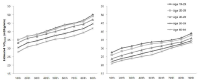
To provide the distribution of cardiorespiratory fitness including Bruce treadmill exercise time and estimated peak oxygen uptake (VO2peak) and investigate association with cardiorespiratory fitness and metabolic syndrome, sedentary lifestyle, or education level among Korean adults. Analysis of data on 2,006 adults (19-64 yr) who had completed a maximal grade treadmill exercise test, from the Sports Institute of Sports Science Fitness Standards (KISS FitS) project 2014-2015. The mean maximal exercise time was 11’26’‘, 11’18’‘, 11’06’‘, 10’03’‘ and 8’51’‘ (minutes and seconds) for men 19-29, 30-39, 40-49, 50-59 and 60-64 years of age, respectively, for women, it was 9’49’‘, 9’09’‘, 8’42’‘, 8’01’‘ and 7’33’‘ for the corresponding age groups. The mean peak oxygen uptake was estimated as 42.3, 41.8, 41.2, 37.6 and 33.6 ml/kg/minute for men 19-29, 30-39, 40-49, 50-59 and 60-64 years of age, respectively, For women, it was 34.0, 31.8, 30.3, 28.0 and 26.4 ml/kg/minute for the corresponding age groups. A positive association between cardiorespiratory fitness level and education level was observed for both men and women. Furthermore, participants with sedentary lifestyle had a significantly lower cardiorespiratory fitness than participants with activity lifestyle. Finally, Men with moderate and high fitness level had 50% and 87% lower odds for the metabolic syndrome, and women had 48% and 50% lower odds for the metabolic syndrome, respectively, than the ones with low fitness level after adjustment for age, smoking, alcohol intake, and sedentary lifestyle. These results can be used to track future Korean assessments and to evaluated interventions. The differences in fitness status by education level, sedentary lifestyle or metabolic syndrome can also be used to develop health policies, program and educational services.
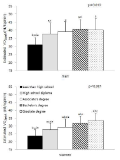
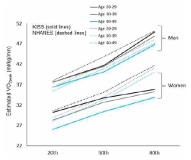
The frailty, characterized by reduced physiological function is closely related to a fall, disability, institutionalization, hospitalization, and mortality in the elderly. A reduced physical fitness is a major phenotype of the frailty. The purpose of this study was to investigate the relationship among pre-frailty, physical activity (PA) and functional fitness in the community dwelling elderly women. The study participants were elderly women (n=338, 70.6±4.2years) aged over 65 who took part in the Korean Healthy Fitness Criteria study for the National Fitness Award Project in 2015. The pre-frailty was defined using the Cardiovascular Health Study frailty criteria. PA was assessed using the International PA Questionnaire (IPAQ). The participants were classified as regular PA participants if they meet the World Health Organization (WHO) PA recommendation for the elderly. Functional fitness was assessed using the composite of the National Fitness Award fitness testing for the elderly. Quality of life was evaluated using EuroQoL visual analogue scale and WHO quality of life assessment. As the results, the pre-frail elderly women were significantly older and obese (body mass index, percent body fat, waist circumference) than the healthy elderly. The pre-frail elderly presented significant decreases in walking, moderate intensity, and total PA compared to the healthy elderly even after adjusted for age and percent body fat. However, no significant difference was found in vigorous-intensity activity between the pre-frail and healthy elderly. Also, the pre-frail elderly women showed the decrease in functional fitness and quality of life compared to the healthy elderly. Regular PA was associated with high levels of muscular endurance and coordination in healthy and pre-frail elderly. In pre-frail elderly, high levels of cardiorespiratory endurance was associated with PA. In conclusion, regular PA is inversely associated with fitness decline in healthy and pre-frail community-dwelling elderly women. Regular PA might attenuate fitness decline in pre-frail elderly women.
The purpose of this study was to examine whether the difference between ingestion of nutrition supplements for 8 weeks can regulate physical activities and fatigue recovery. Fifty one middle-aged women participated in this study and were divided into placebo, ingestion of 20g energy supplement and ingestion of 40g energy supplement groups. Energy supplement mainly consists of carbohydrates and proteins. All subjects take in this supplement one time per a day for 8 weeks. Physical activity and fatigue recovery were measured before and after ingestion of energy supplement for 8 weeks by using the Wingate anaerobic and a blood tests. In the Wingate anaerobic test, the peak power(p<.01) and average power(p<.05) were significantly increased in ingestion of 20 and 40g supplement groups compared to the placebo group. Although concentrations of lactate and growth hormone in the blood didn’t show a significant differences among groups, blood concentrations of cortisol and ammonia were further enhanced in ingestion of 20 and 40g supplement groups compared to the placebo group(p<.001). The results of present study provide evidence that energy supplement mixed with carbohydrates and proteins may be effective to increase physical activity as well as to reduce blood concentration of fatigue-related factors after exercise.
