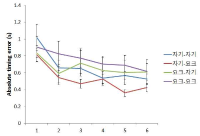
Purpose The present study was set up to investigate the effect of self-regulated learning and selection of feedback on learning of the relative and absolute timing. Methods 48 university student volunteers participated in the experiment and were randomly assigned four groups (n=12 for each) depending on practice task and feedback, namely: 1) self-regulated practice task - self-controlled feedback (self-self), 2) self-regulated practice task - york-controlled feedback (self-york), 3) york-regulated practice task - self-controlled feedback (york-self), and 4) york-regulated practice task - york-controlled feedback (york-york). The task was to examine the temporal timing error and the task goal was to press a computer keyboard 'J' and 'K' alternatively corresponding to time set. Prior to the experiment, the participants had a pre-practice session and then practiced one of three timing tasks provided by an experimenter in the acquisition phase. There were two transfer test to assess adaptability aspects of performing changes related to learning after 24 hours of the acquisition phase. Serial practice was applied in the transfer 1 and an effector transfer was examined in the transfer 2. The dependent variables were a relative timing error that is susceptible to discrepancy between the participant’s key press and the goal patterns and an absolute timing error that is susceptible to discrepancy in the time required to perform the sequence compared to the goal absolute time. Results The results showed that in the pre-test there was no significant difference in both the relative and absolute timing error across four groups. However, in acquisition phase there was a significant difference in both the relative and absolute timing error across block. The relative timing error was different across the group in the transfer test 1, however it was different only between the self-self and york-york group. Lastly, the absolute timing error was not different across the groups in the transfer test 2. Conclusion The findings revealed that the self-regulated strategy is effective to learn the relative timing in the effector transfer.