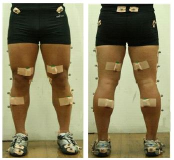
The purpose of this research is to investigate the factors affecting the performance capability of lunge movements by performing lunge movements which are commonly used as a method of instant physical movement in sports with a kinetic analysis including an EMG analysis. This research targeted 14 skilled fencers and made the subjects perform kick-lunges which allow them to go farthest from their positions and performed an analysis on such, applying a 3D motion analysis system and an EMG system. The subjects performed kick-lunges in two movements; one with a preliminary movement and the other without it and those are performed with both dominant leg and non-dominant leg. The result of this research is as follows. The lunges with a preliminary movement showed higher performance capability than those without it. Furthermore, as the level of skills gets higher, the length of lunges gets longer, and it seemed that a tactical mechanism shortening exercise performance times was used as a mechanism to control the impulse coming from such lengthened lunges. In addition, a difference appeared in mechanical factors such as moment and power in a dominant leg movement and it seemed to result from a difference in an functional capability using muscles.

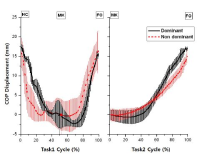


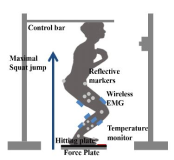
The human foot is only part that directly contact between the body and the external environment, and is ideally positioned to provide sensory information to the Central Nervous System (CNS) during static and dynamic tasks. Through cutaneous mechanoreceptors located in the dermis, the foot is able to recognize touch pressure and vibration stimuli, which provide important feedback information used for the fine coordination of movements. The purpose of this study is to quantitatively examine the effect of changing the foot cutaneous sensory by temperature stimulus on maximal performance and muscle activation using wavelet technique. Sixteen healthy subjects volunteered to participate in this study (Male: Age 21.4±2.4years; Height 174.7±5.3츠; Weight 70.6±5.2kg; Female: Age 20.5±0.6years; Height 163.2±3.1cm; Weight 55.6±4.8kg). Sensory pressure thresholds were determined for the plantar surface of the foot using monofilament. Kinematic, kinetic and EMG data which relative to maximal performance were collected while squat jumping in each temperature condition(cool 12-15℃ normal 28-30℃ hot 45-48℃). Maximal jump height was significant higher in normal condition. Vertical GRF in normal condition showed higher peak value the other conditions. And then EMG signal were significant different between temperature conditions during maximal performance. By changed sensory feedback on temperature, one can alter maximal performance and muscle activation pattern. Cutaneous feedback is important in performance and neuromuscular control, and temperature changes significantly influence on lower extremity during maximal squat jump performance of healthy subjects.