
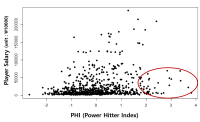
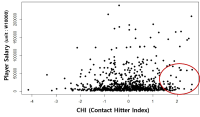
Purpose The main purpose of this current study is two-fold. Firstly, it attempts to develop a model to determine the true market value of Korean professional baseball players (hitters only) solely based on their athletic performances on the field. Secondly, it is to provide the evidential data for the market value of baseball players in Korea. Methods The statistical data and performance information were obtained from baseball almanac from KBO from 1997 to 2016. Seven hundred and ninety three players were included for data analysis. Principal component factor analysis was utilized to eliminate multicollinearity among 12 sabermetrics indices (OPS, GPA, SECA, TA, RC, RC/27, XR, ISO, PSN, sOBA, %OW, BABIP) and increase power of explanation of the proposed model with KMO(=0.77), p<0.001. Results The proposed model was successfully developed with YSalary = Years of Experience*921.5 + FA (free agent)*53528.9 + PHI(Power Hitter Index)*7313 + CHI(Contact Hitter Index)*5893.6. Furthermore, the proposed model explained 64.5% of variances of the market value for the Korean professional baseball players and proved to be statistically valid. Conclusions The newly developed model in this study was very helpful for us to identify the variables that affect the true market value of baseball players. It is expected that this model could make an important contribution in determining true market value of the baseball players in Korea.
PURPOSE This study aimed to a) develop suitable screening tools for identifying gambling severity in Korea and b) explore factors that affect the gambling severity index in order to prevent Korean sports betting users from easily falling into gambling addiction, thus providing practical and useful guidelines in this regard. METHODS This study examined Korean sports fans who had experiences of participating in sports betting (Sports Toto), a legal sports betting system in Korea. Toward this end, an online survey was conducted from May 10 to June 25, 2022. A total of 214 questionnaire results, excluding 23 who gave insincere and/or incomplete answers, were analyzed for normal distribution through skewness and kurtosis, and subscale scores were calculated after performing exploratory factor analysis and reliability analysis using Cronbach’s α. RESULTS A psychological gambling severity index and behavioral gambling severity index were developed based on a stepwise regression analysis, which was conducted using the demographic characteristics of domestic sports betting participants and their lifestyle habits (e.g., smoking and drinking, problem gambling severity index, self-control scale, and gambling expectation scale). CONCLUSIONS First, factors affecting the psychological gambling severity index were identified (having a job, job stability, and security) along with lifestyle habits (smoking and drinking). Second, gender, occupational characteristics, full-time employment, confidence in self-control, and desire for self-improvement were indicated as significant factors that influenced the behavioral gambling severity index.
