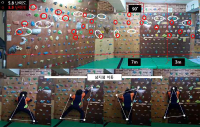
[Purpose] The study was designed to examine the effects of a 10-week sports climbing training on body composition and surrogate indices of major lifestyle disease in obese elderly women. [Methods] Twenty elderly women, whose percent body fat was over 35%, were randomly assigned into one of two groups, i.e., sports climbing training group (TR: n=10) and control group (CON: n=10). The subjects in TR completed sports climbing training program with 5.8 and 5.9 of difficulty, at 11-13 of ratings of perceived exertion (RPE), 60 min/session, three sessions/wk for 10 weeks. Independent variables regarding body composition and major lifestyle disease, i.e., hypertension, dyslipidemia, and atherosclerosis, were measured and compared between two groups as well as between two tests simultaneously using a repeated two-way ANOVA. [Results] Regarding physique and body composition, there were significant interactions between group and test in body weight, body mass index, fat mass, and percent body fat. These variables decreased significantly in TR. 2) Regarding indices of hypertension, systolic blood pressure, diastolic blood pressure, mean arterial pressure, and pulse pressure decreased significantly in TR. Regarding indices of dyslipidemia, triglyceride decreased significantly in TR. Regarding indices of atherosclerosis, TG/HDL-C ratio decreased significantly in TR. [Conclusions] It was concluded that the 10-week sports climbing training would be beneficial for reduction of body fat despite its’ influence on fat-free mass was limited, and would also contribute on improving surrogate indices of hypertension, dyslipidemia, and atherosclerosis in obese elderly women. Future research investigating the effects of various period, intensity, duration, and frequency of sports climbing training would be warranted.
Purpose The purpose of this study was to investigate the effect of a 10-week aerobic exercise training on cardiovascular function, atherosclerosis, and vascular endothelial function in elderly women. Methods Twenty impaired fasting glucose (IFG) and normoglycemic elderly women volunteered to participate in the study. The participants in aerobic exercise training group (TR: n=9) completed 20-40 minutes of aerobic exercise program at 30-50% HRR for 3 times per week during 10 weeks. The participants in control group (CON: n=11) were asked to maintain their normal life pattern during the same intervention period. Results Main results of the study were as follows: 1) There were no significant main effect or interaction in body weight, fat-free mass, fat mass, percent body fat, and body mass index. 2) There were no significant main effect or interaction in heart rate, stroke volume, cardiac output, total peripheral resistance (TPR), systolic blood pressure, diastolic blood pressure, mean arterial blood pressure, pulse pressure, and rate pressure product. However, interaction between group and test in TPR was close to statistically significant level (P =.054), and it tended to be decreased in TR group. 3) There was a significant main effect of test in high sensitivity C-reactive protein(hs-CRP), it tended to be decreased in TR group. There were no significant changes in total cholesterol(TC)/high density lipoprotein-cholesterol (HDL-C) ratio, triglyceride/HDL-C ratio, and low density lipoprotein-cholesterol/HDL-C ratio. 4) There were significant main effect of group, main effect of test, as well as interaction between group and test in % flow mediated dilation(FMD), and it increased significantly (P<.01) in TR group. Nitric oxide tended to be increased in TR group, even though it did not change significantly in both groups. Conclusions It was concluded that the 10-week aerobic exercise training would be beneficial for improvement of vascular endothelial function, resulting from the decrement of total peripheral resistance.
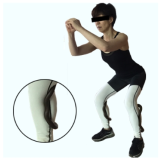
Purpose This study was designed to investigate the effects of weight-bearing exercise and CareRing treatment on cardiovascular responses, popliteal vein functions, and vascular elasticity of 30-40s women who had worked longer than eight hours a day in a standing position. Methods Thirteen subjects participated in 30 min of standing up treatment (STAND), weight-bearing exercise treatment (EX), and weight-bearing exercise with CareRing treatment (EX+RING). Each subject took part in the three trials repeatedly in a counter-balanced order and proceeded with a wash-out period of at least one week between the respective trials. Results The main results were as follows: 1) Significant reduction in EDV, no change in the diameter of popliteal vein, trend of reduction in blood flow of popliteal vein, and increased baPWV, indicating reduction of vascular elasticity of whole body, were shown in the STAND. 2) CO and EF increased significantly, and TPR decreased significantly in the EX. Blood flow velocity and blood flow volume of popliteal vein increased significantly, and baPWV decreased significantly from immediately after the treatment throughout the recovery phase in the EX. 3) HR, CO, and EF increased significantly in the EX+RING. Blood flow velocity and blood flow volume increased significantly in the EX+RING. Diameter of popliteal vein increased significantly immediately after the treatment and decreased significantly at 40 minutes of recovery. TPR and baPWV decreased significantly immediately after treatment compared to the STAND. Conclusions It was concluded that weight-bearing exercises would be effective in preventing venous or cardiovascular diseases occurred due to long-standing in 30-40s women, who are at high risk for such diseases. Furthermore, it would be more effective to combine pressure treatment with CareRing during weight-bearing exercises.
