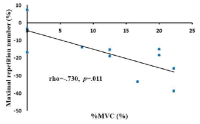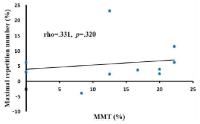
The purpose of this study was to determine whether maximum repetition number can be used as an indicator of strength imbalance. Eleven healthy, resistance-trained males were tested for one repetition maximum (1-RM) the chest-press exercise, and than manual muscle testing (MMT), two-arm at 80% of 1-RM and one-arm at 40% of 1-RM in the pectoralis major were measured for the maximum voluntary contraction (%MVC) and maximum number of repetitions during the chest press exercise. Exercise velocity was constantly 4 seconds (concentric: 2-s, eccentric: 2-s) per repetition. The changes in %MVC were significantly higher in non-dominant limb (NDL) compared with dominant limb (DL) pectoralis major during two-arm chest press (p < 0.01) and one-arm chest press exercise (p < 0.05). In contrast, the changes in MMT (p < 0.05) and maximum repetition number (p < 0.01) were significantly higher in DL compared with NDL during one-arm chest press exercise. There was no correlation between maximum repetition number and MMT (rho = 0.331, p = 0.320). However, maximum repetition number was significantly negative correlated with %MVC in two-arm chest press (rho = -0.730, p = 0.011). It is possible that maximum repetition number can be used as an indicator of strength imbalance.