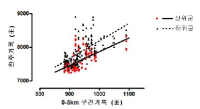
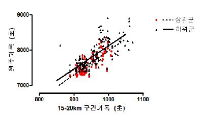
The purpose of this study was to examine that the reciprocal relationship between every 5km and full course running time record. In this study we extended our research scope to investigate whether any notable running time differences were existed among top level of marathoners. Comparisons were made using data which were drawn from 34 championship competitions had been held between year 2000 and year 2009 in Korea. Total 340 full time data was obtained from 340 marathoners who successfully completed their 42.195km running race, and divided into one of two categories, either upper ranked group (URG, ranked 1st~5th position in competitions they participated) or lower ranked group (LRG, ranked 6th~10th position in competitions they participated). Mean and standard deviation were calculated from SPSS (VER. 20.0), and repeated measures of ANOVA and Pearson's correlation was adopted to perform statistical analyses. There was no statistical difference of the running record during first 5km, however running time form all other 5km running sections was significantly faster in URG than LRG (p<.001). The gap of running time record between URG and LRG was getting more and more significant after 20km running. The quickest running record was found during 2nd 5km section (i.e., 5~10 km) and the each section's race time was getting drastically slower during 6th~7th 5km section running regardless of the study groups. Drawn conclusions from this study were that athletes use the strategy of deciding victory in both the beginning and the latter phase of marathon running. This implies that athletes who have the capacity, which make them run faster than others during the very beginning of marathon competition, and/or during 25~35km running sections would be the most preferable for the victory at the finish line.




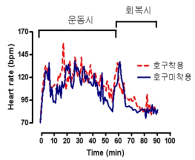
The purpose of this study was to investigate the effect of wearing of safeguard devices on various blood ions (i.e., Na+, K+, Ca2+) concentrations, gas parameters (PO2, PCO2, hematocrit [Hct], hemoglobin [Hb], Saturated [Sat] O2), and energy substrates (i.e., glucose, free fatty acid [FFA], lactate) concentrations during Kumdo training. Research scope extended to examine the heart rate changes during each exercise sessions. In order to achieve the research goal, 10 male elite Kumdo players, who play for G city in Gyeongsangbuk-do, were participated, and their mean maximum oxygen uptake level was 51.2(±6.1)mL· kg-1min-1. All subjects undertook Kumdo training sessions twice, which carefully pre-planned and consisted of routinely carrying out exercise program. Training period for each session was 80 min long including 10 min each for warm-up and warm-down period, but the conditions with wearing body protection devices were different following either with wearing complete set of safeguard devices or without wearing any safeguard devices except general training cloth. Heart rate was measured by every minute interval. K+ and Ca2+ showed interaction effect between the conditions with wearing safeguard devices and conditions with time of Kumdo training. Hct and Hb level significantly increased after 60 min Kumdo exercise regardless of wearing safeguard devices. Kumdo training induced dropping of blood pH independently with wearing safeguard device conditions, however the values and/or concentrations of PO2, Na+, glucose, lactate, Sat O2were significantly increased. Heart rate was maintained marginally higher values throughout exercise period when safeguard devices were worn. Based on these results, it was concluded that wearing the safeguard devices could possibly be causing a physiological metabolic changes, and this may be drawn by increased body fluid loss and energy expenditure. Further study should be undertaken to examine the effects of wearing safeguard devices on hitting intensity and hormone secretion and concentrations, that closely associated with body fluid and ion balance during Kumdo exercise and/or training.
