It has been known that β-alanine supplementation induce the increment of carnosine in vivo and was effective in delaying fatigue by buffering the hydrogen which was formed during exercise. This study was designed to investigate the effects of 4 weeks of β-alanine supplementation on physical fitness and blood lactate concentration in middle school soccer players. Nineteen middle school soccer players were randomly assigned to either one of two groups, i.e., β-alanine group (n=10) and placebo group (n=9). Subjects in β-alanine group consumed β-alanine 2 g/day during 1st and 2nd week, as well as 3 g/day during 3rd and 4th week, whereas subjects in placebo group consumed maltodextrin in the same manner. All subjects ate same menu and trained same amount at the same training camp during the intervention period. Body composition, aerobic capacity, anaerobic capacity, isokinetic function, and blood lactate concentration during maximal GXT were measured at pre- and post-test. Main results of the present test were as follows: 1) Fat mass and percent body fat decreased significantly in β-alanine group. 2) No significant changes were found in variables related to aerobic capacity in both groups. 3) Average power increased significantly in β-alanine group. 4) Isokinetic muscular endurance increased significantly in β-alanine group. 5) Blood lactate concentration did not change in eithet group; however, blood lactate concentration immediately after maximal GXT in β-alanine group tended to be increased more than placebo group. It was concluded that β-alanine supplementation would have positive effects for improvement of body composition, anaerobic capacity, and muscular endurance in middle school soccer players.

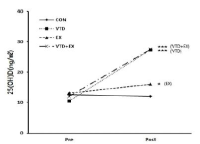
The objective of this study was to investigate the effects of 12-weeks of vitamin D supplementation and circuit training on skeletal muscle mass in elderly women with type 2 diabetes mellitus and vitamin D deficiency. Forty eight elderly women with type-2 diabetes mellitus and vitamin D deficiency were randomly assigned to control(n=10), vitamin D supplement(n=11), exercise(n=12), and vitamin D supplement+exercise(n=15) groups. Dependent variables were measured before and after the 12-week interventions. Major outcomes included body composition, fasting glucose, insulin, and 25(OH)D concentration. ASM(apeendicular skeletal muscle mass), SMI(skeletal muscle mass), and HOMA-IR (homeostasis model for insulin resistance) were calculated. Women assigned to the vitamin D supplement consumed 1,200 IU of vitamin D orally per week for 12 weeks. Women assigned to the exercise intervention performed a circuit training at an intensity of 60%~80% of HRmax with a frequency of 3 days per week for 12 weeks. Compared to control group, all groups had significant loss of body weight and increases in serum 25(OH)D after the 12-week intervention. ASM and SMI increased significantly in only vitamin D+exercise group. Regardless of treatments, no significant group differences were found in changed scores of fasting glucose, insulin, and HOMA-IR. In conclusion, vitamin D + exercise would improve the loss of ASM and SMI compared with vitamin D or exercise alone.