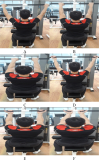
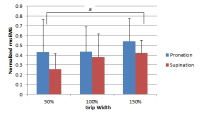
Purpose The purpose of this study is to investigate the effects of grip width and hand orientation on muscle activities of upper body during the lat pull-down. Methods Eight healthy men performed the 6 grip variations (3 grip width × 2 hand orientation) using an experimentally determined load of 70% of 1 repetition maximum. Five trials were analyzed for each grip type. Participants maintained a cadence of 2-second concentric and 2-second eccentric phases. The grip widths were normalized for each individual by using their biacromial diameter (100%), and then set the grip width 50% of biacromial diameter and 150% of biacromial diameter. Surface EMG of the latissimus dorsi, pectoralis major, infraspinatus, biceps brachii, triceps brachii, rectus abdominis, erector spinae and middle trapezius was recorded, and the root mean square of the EMG was normalized, using a maximum isometric voluntary contraction. Results Latissimus dorsi showed higher muscle activities in 100% grip width than those of 50% grip width. Pectoralis major and rectus abdominis showed higher muscle activities in 50% and 100% grip width than those of 150% grip width. Middle trapezius showed higher muscle activities in 150% grip width than those of 50% grip width. Conclusions Two-way repeated measures ANOVA for each muscle revealed that latissimus dorsi and middle trapezius (the posterior muscles of trunk) showed higher muscle activities in wide grip, on the other hand, pectoralis major and rectus abdominis (the posterior muscles of trunk) showed higher muscle activities in narrow grip.




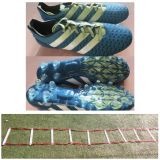
Purpose The purpose of this study was to investigate the lower extremity muscles activity during forward side step by soccer field ground types. Methods Fifteen elite high school soccer players participated in this study. Muscle activation patterns were recorded at 2000 Hz during forward side step task. Surface EMG of the tibialis anterior(TA), soleus(SOL), medial gastrocnemius(MG), lateral gastrocnemius(LG), peroneus brevis(PB) muscle was recorded, and the root mean square of the EMG was normalized, using a maximum voluntary isometric contraction(%MVIC). One-way repeated ANOVA was used for comparison among three soccer field ground types(natural grass, artificial turf, hard ground). Results Artificial turf displayed greater soleus and peroneus brevis activities compare to natural grass during forward side step task. Conclusions The relationship between increased soleus and peroneus brevis activation and greater incidence of injury in artificial turf versus natural grass requires further study. Soccer players routinely training on artificial turf for prolonged periods should be carefully monitored.

PURPOSE The purpose of this study is to analyze the biomechanical variables involved in ballet dancers’ ankle muscle imbalance when performing relevé movements. METHODS The subjects of this study (n=14, age: 22.29±1.73 years old, height: 161.4±5.06cm, weight: 51.88±7.51kg) were 14 ballet dancers with 9 years of experience. Based on the reciprocal muscle strength ratio, the dancers were divided into the following groups: Close to the normal value (RMIS) and far from the normal value (RMIB) using the maximum values of plantar flexion and dorsiflexion of the ankle joint using an isokinetic measurement equipment (60°/sec). RMIB). The biomechanical variables, namely the ankle joint movement and ground reaction force, were subsequently measured. SPSS 26.0 was used for data analysis and independent t-test was used for statistical verification. RESULTS The ground reaction force in the Z (vertical) direction based on the ankle joint muscle strength imbalance of ballet dancers was significantly lower in the RMIB group. In addition, although it was not a statistically significant difference, the plantar flexion movement was lower in the RMIB group, and there was a significant difference in the generation of ankle joint movement in the Z direction. CONCLUSIONS In conclusion, in order for a ballet dancer to efficiently utilize the force generated from the supporting leg when performing a movement, ankle imbalance must be taken into consideration when training.
