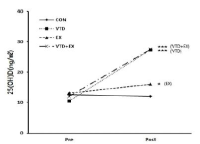
The objective of this study was to investigate the effects of 12-weeks of vitamin D supplementation and circuit training on skeletal muscle mass in elderly women with type 2 diabetes mellitus and vitamin D deficiency. Forty eight elderly women with type-2 diabetes mellitus and vitamin D deficiency were randomly assigned to control(n=10), vitamin D supplement(n=11), exercise(n=12), and vitamin D supplement+exercise(n=15) groups. Dependent variables were measured before and after the 12-week interventions. Major outcomes included body composition, fasting glucose, insulin, and 25(OH)D concentration. ASM(apeendicular skeletal muscle mass), SMI(skeletal muscle mass), and HOMA-IR (homeostasis model for insulin resistance) were calculated. Women assigned to the vitamin D supplement consumed 1,200 IU of vitamin D orally per week for 12 weeks. Women assigned to the exercise intervention performed a circuit training at an intensity of 60%~80% of HRmax with a frequency of 3 days per week for 12 weeks. Compared to control group, all groups had significant loss of body weight and increases in serum 25(OH)D after the 12-week intervention. ASM and SMI increased significantly in only vitamin D+exercise group. Regardless of treatments, no significant group differences were found in changed scores of fasting glucose, insulin, and HOMA-IR. In conclusion, vitamin D + exercise would improve the loss of ASM and SMI compared with vitamin D or exercise alone.
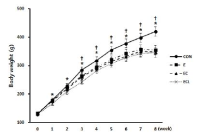
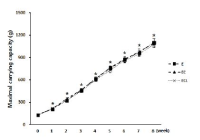
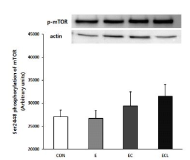
The purpose of this study was to examine the effect of dietary creatine and leucine supplementation on protein synthesis and functional properties of skeletal muscle during 8 weeks of resistance exercise. Thirty two male Sprague-Dawley rat(5 weeks old) were randomly divided into four groups(8 rats per group): sedentary control group(CON), execise group(E), exercise with creatine supplementation group(EC), exercise with creatine, leucine supplementation group(ECL). Exercise groups were trained to climb a ladder with a weight secured to their tails(3day/week). The supplementation was administrated daily through oral gavage. Creatine supplementation was given at 250㎎/㎏/day. Creatine+leucine supplementation was given at 250+250㎎/㎏/day. All exercise groups presented significantly lower epididymal fat mass than CON(p<.05). E presented significantly higher plantaris mass than CON(p<.05). All exercise groups significantly presented higher FHL mass than CON(p<.05) and E presented higher FHL mass than EC, ECL(p<.05). EC, ECL presented significantly lower expression of Akt/PKB protein than CON, E(p<.05). There was no difference in the expression of mTOR protein. The results suggest that the creatine and leucine supplementation does not promote any additional hypertrophic effect on resistance trained skeletal muscle. But, creatine and leucine supplementation might have a potential benefit on skeletal muscle hypertrophy through the activation of protein synthesis.