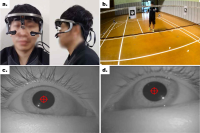
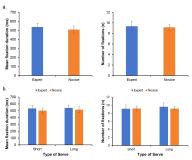
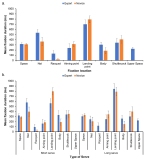
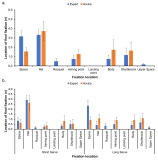
[Purpose] The purpose of this study was to examine the differences in visual search strategies between expert and novice badminton players while performing badminton serve. [Method] To this end, expert (more than 10 years experience) and novice (less than 6 months experience) badminton players performed 15 trials of two types of serve (i.e., short-serve and long-serve), in total 30 trials. All the participants’ eye movement was recorded during each trial, and mean fixation duration, fixation distribution, final fixation duration and location, and gaze entropy were analyzed. [Results] The results showed that there was no difference in mean fixation duration between expert and novice players. The analysis of mean fixation duration on each location showed that participants fixated more on the net while doing short serve whereas fixated more on the space when they did long serve. In particular, expert players fixated more on the space while doing long serve than novice players, and fixated more on the net and racquet for the short serve. However, novice players fixated more on the location of shuttle would be landed. The final fixation duration was not different between expert and novice players. Further, expert players showed higher gaze entropy than novice players. [Conclusion] The findings indicate that expert players fixated more on the net for the short serve, and the space for the long serve, and visual search strategies of experts were more varied than novice players.

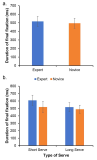
PURPOSE The main purpose of this study was to examine the difference in visual search strategies based on the skill level in success and failure cases in badminton short serves. METHODS To this end, six badminton experts (experience: more than 10 years) and six novices (less than 1 years) participated. The participants’ eye movement was recorded during each trial, and mean fixation duration, mean saccade amplitude, percentage of viewing time on each fixation location, final fixation duration, and gaze entropy were analyzed. RESULTS First, the mean fixation duration did not differ significantly, but the mean saccade amplitude increased when expert players failed to perform the serve successfully. Second, the percentage of viewing time on each location results showed that the overall viewing time was lower when the performance was unsuccessful, and the expert players fixated longer time viewing the net and space when they made a successful serve. Third, expert players showed longer QE than novice players when they made a successful serve. Finally, the gaze entropy results showed that expert players showed greater gaze entropy during successful performance, indicating that the gaze pattern was randomly distributed across trials. CONCLUSIONS When learning a badminton serve, we should fully recognize and explore the receiver’s location and external environment, and subsequently, before initiating serve movement, focus on the net or space between the receiver’s racquet and shoulders to make a more successful performance. In addition, we should make various patterns of the visual search strategy, rather than the fixed or consistent search strategy, to deceive receivers.
