PURPOSE This study aimed to analyze the differences in center of pressure (COP) and sample entropy (SampEn) between the right and left supporting legs during a single-leg stance task involving vertically and horizontally moving visual stimuli tracking. The objective was to examine the directional processing of visual information and functional asymmetry of the feet in postural control, providing foundational data for balance training design. METHODS This study recruited 20 right-footed adult men (mean age = 26.84 ± 4.47 years) who scored >7 on the Waterloo Footedness Questionnaire-Revised. The participants performed a 30-second single-leg stance while tracking visual stimuli with their gaze under different directional conditions. RESULTS Significant differences were observed across gaze directions in all COP and SampEn variables, with the left–right condition yielding the highest values (p < .05). Regarding the supporting leg, a significant difference was observed only in SampEn values in the anteroposterior direction. Moreover, a significant interaction effect between gaze direction and supporting leg was noted in SampEn in the mediolateral direction. CONCLUSIONS These findings suggest that the right and left supporting legs use different postural control strategies. Specifically, the left supporting leg demonstrated a tendency to adopt more complex and adaptive control mechanisms under horizontal gaze shifts, indicating functional asymmetry in postural regulation.
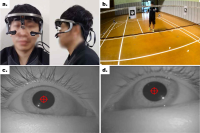
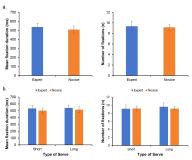
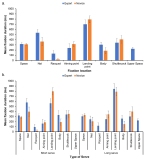
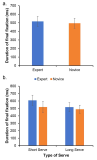
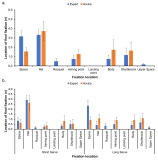
[Purpose] The purpose of this study was to examine the differences in visual search strategies between expert and novice badminton players while performing badminton serve. [Method] To this end, expert (more than 10 years experience) and novice (less than 6 months experience) badminton players performed 15 trials of two types of serve (i.e., short-serve and long-serve), in total 30 trials. All the participants’ eye movement was recorded during each trial, and mean fixation duration, fixation distribution, final fixation duration and location, and gaze entropy were analyzed. [Results] The results showed that there was no difference in mean fixation duration between expert and novice players. The analysis of mean fixation duration on each location showed that participants fixated more on the net while doing short serve whereas fixated more on the space when they did long serve. In particular, expert players fixated more on the space while doing long serve than novice players, and fixated more on the net and racquet for the short serve. However, novice players fixated more on the location of shuttle would be landed. The final fixation duration was not different between expert and novice players. Further, expert players showed higher gaze entropy than novice players. [Conclusion] The findings indicate that expert players fixated more on the net for the short serve, and the space for the long serve, and visual search strategies of experts were more varied than novice players.

PURPOSE This study investigated differences in gaze entropy according to skill level and temporal occlusion in table tennis serve reception. METHODS Study participants were divided into a skilled group (n = 6) and a novice group (n = 6). The study task involved sitting in front of a monitor while wearing an eye tracker, watching 36 serve videos, and predicting whether the ball’s length would be short or long by pressing the "Top" (short serve) or "Bottom" (long serve) pad on the selection response pad. RESULTS Overall, the later the temporal occlusion level, the faster the reaction time and the higher the judgment accuracy. At temporal occlusion levels 2 and 3, skilled participants showed higher judgment accuracy than novices. Analysis of heatmap and gaze entropy revealed that novices exhibited visual search toward the ball across all temporal occlusion levels (T1, T2, T3) and had high gaze entropy. In contrast, skilled participants generally showed visual search to the racket area depending on the temporal occlusion level, with low gaze entropy at T1 and T2, and a tendency for increased gaze entropy at T3. CONCLUSIONS Compared to novices, skilled participants had lower gaze entropy and fixated more on the racket area when predicting table tennis serves. Similarly, novices focused more on the ball than on the racket. The study also proposed the value of using heatmap and Shannon entropy for this type of analysis.
