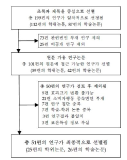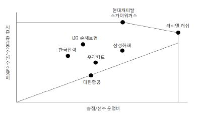
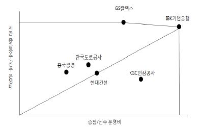
Professional volleyball league, which was launched and its popularity was steadily increased since 2005, has suffered from difficulties in its operation due to deficits after 2013. In addition, each professional volleyball team has worked out for parent company so far as a means of advertisement but does not look like effective management. Therefore, the purpose of this study was to evaluate each professional female and male volleyball team management efficiency through Data Envelopment Analysis. Player salary for the input variable and points and the number of spectators for output variable were used respectively then data were analyzed using Frontier Analyst 4.0. The results were as follows. First, Hyndai capital and Rush & Cash recorded the most efficient management among all professional male volleyball team. On the other hand, Samsung showed inefficient management, followed by LIG, KEPCO, Woori Card, and Korean Air. Second, GS Caltex and IBK were discovered as the highest management efficiency among all professional female volleyball team. On the contrary, KGC recorded inefficient management, followed by Korea Expressway Corporation, Hyundai Construction and Heungkuk life.
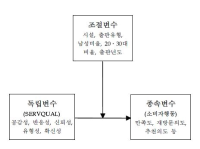
The current study aimed to investigate the impact of SERVQUAL on sport consumer behaviors using meta-analytic techniques. Findings from 25 dissertations and 26 journal articles were used to test of a model of the SERVQUAL on various sport consumer behaviors via the comprehensive meta analysis (CMA) program. Results showed that SERVQUAL has a large effect on sport consumer behaviors, with a fixed effect size of .383. In terms of the relative importance of the SERVQUAL sub-factors, sport consumer behaviors were influenced most by empathy, followed by reliability and tangibles. In predicting sport consumer behaviors, SERVQUAL had a most positive effect on, in order of, loyalty, customer orientation, and commitment. Results also found significant moderating evidence for sport facility types, publication types, publication year, the ratio of male and respondents' age.