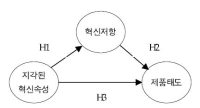
The Purpose of this study was to examines the effect of smart sport wear's innovation attribute on product attribute, focused on innovation resistance. Data were drawn from 253 college students and graduate college students in three different university. The model was tested using SPSS/PC ver. 18.0 for windows and AMOS 20.0 program. Data were analyzed using frequency analysis, reliability analysis, confirmatory factor analysis, correlation, and structural equation modeling techniques. The statistical significance level was set at a<.05. The results were as follows. First, perceived attributes of smart sport wear had a negative effect on innovation resistance. Second, innovation resistance had a negative effect on product attribute. Third, perceived attributes of smart sport wear had a positive effect on product attribute. Forth, innovation resistance partially mediated the relationship between perceived attributes of smart sport wear and product attribute.


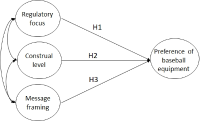
Purpose The purpose of this study was to analyze the propensity to consume the consumer of the baseball equipments who have difference of the product preference by regulatory focus, and who have construal level and suitable message framing. Methods Populations are consumers who have purchased the baseball equipments before, and the sampling groups, five different society baseball group’ league from Seoul and Kyeongi-do, were distributed, 318 copies, by convenience sampling. The questionnaire proceeded by three-way completely randomized design with stimulated sentences of four different advertisement compartmentalized by the regulatory focus, construal level and message framing. The analysis utilized SPSS 21.0 to perform the frequency analysis, manipulation check, independent t-test, two-way ANOVA, and Scheffe was used to post-hoc. Therefore, the result of this study is as below. Results First, after analyzing the distinction of the regulatory focus of the consumers of baseball equipments, the preference of the consumer who has improving focus was higher than that of consumer who has the prevention focus. Second, preference differentiation analyzed by construal level and the message framing of the consumer of the improving focus, the preference was higher when the message framing was positive, and the construal level was in short time. Third, preference differentiation analyzed by construal level and the message framing of the consumer of the prevetnion focus, there was no difference of the preference of the equipments followed by the construal level and message frame for prevention focus consumers.
