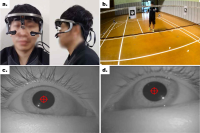
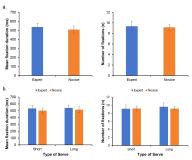
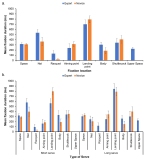
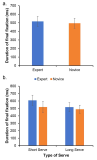
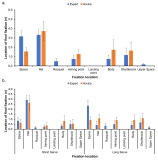
[Purpose] The purpose of this study was to examine the differences in visual search strategies between expert and novice badminton players while performing badminton serve. [Method] To this end, expert (more than 10 years experience) and novice (less than 6 months experience) badminton players performed 15 trials of two types of serve (i.e., short-serve and long-serve), in total 30 trials. All the participants’ eye movement was recorded during each trial, and mean fixation duration, fixation distribution, final fixation duration and location, and gaze entropy were analyzed. [Results] The results showed that there was no difference in mean fixation duration between expert and novice players. The analysis of mean fixation duration on each location showed that participants fixated more on the net while doing short serve whereas fixated more on the space when they did long serve. In particular, expert players fixated more on the space while doing long serve than novice players, and fixated more on the net and racquet for the short serve. However, novice players fixated more on the location of shuttle would be landed. The final fixation duration was not different between expert and novice players. Further, expert players showed higher gaze entropy than novice players. [Conclusion] The findings indicate that expert players fixated more on the net for the short serve, and the space for the long serve, and visual search strategies of experts were more varied than novice players.


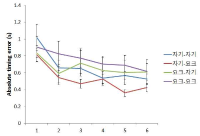
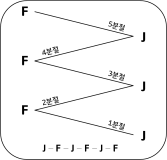
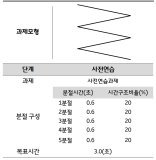
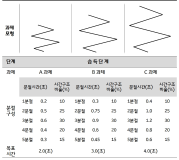
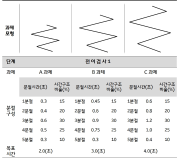
Purpose The present study was set up to investigate the effect of self-regulated learning and selection of feedback on learning of the relative and absolute timing. Methods 48 university student volunteers participated in the experiment and were randomly assigned four groups (n=12 for each) depending on practice task and feedback, namely: 1) self-regulated practice task - self-controlled feedback (self-self), 2) self-regulated practice task - york-controlled feedback (self-york), 3) york-regulated practice task - self-controlled feedback (york-self), and 4) york-regulated practice task - york-controlled feedback (york-york). The task was to examine the temporal timing error and the task goal was to press a computer keyboard 'J' and 'K' alternatively corresponding to time set. Prior to the experiment, the participants had a pre-practice session and then practiced one of three timing tasks provided by an experimenter in the acquisition phase. There were two transfer test to assess adaptability aspects of performing changes related to learning after 24 hours of the acquisition phase. Serial practice was applied in the transfer 1 and an effector transfer was examined in the transfer 2. The dependent variables were a relative timing error that is susceptible to discrepancy between the participant’s key press and the goal patterns and an absolute timing error that is susceptible to discrepancy in the time required to perform the sequence compared to the goal absolute time. Results The results showed that in the pre-test there was no significant difference in both the relative and absolute timing error across four groups. However, in acquisition phase there was a significant difference in both the relative and absolute timing error across block. The relative timing error was different across the group in the transfer test 1, however it was different only between the self-self and york-york group. Lastly, the absolute timing error was not different across the groups in the transfer test 2. Conclusion The findings revealed that the self-regulated strategy is effective to learn the relative timing in the effector transfer.




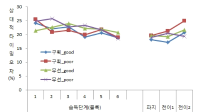
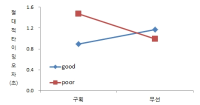
The present study was conducted to determine the effect of contextual interference (CI) and motivational properties (MP) of Knowledge of Result (KR) in learning on relative and absolute timing. Participants (N=48) were randomly assigned to one of four practice groups, which differed in practice structure on CI (blocked, random) and KR on MP (good trial, poor trial). They performed temporal timing tasks in pre-exercise and acquisition phase and went through a retention test and 2 transfer tests after approximately 24 hours. The main findings showed that first, for the relative timing error there was no significant main effect of CI and MP in the acquisition phase, retention, transfer1, and 2 test. However, there was a significant interaction effect between CI and MP in the transfer 2 test. Second, for the absolute timing error there was no significant main effect of CI and MP in the acquisition phase, retention, and transfer test 2 while there was in the transfer test 1. Moreover, there was a significant main effect between CI and MP in the retention, transfer 1, and 2 test. The findings indicated that 1) there was a significant learning effect of absolute timing between KR_good group and KR_poor group on blocked practice in the retention test, 2) random practice schedule and KR_good condition resulted in enhanced absolute timing performance relative to blocked practice and KR_poor respectively at transfer test 1, 3) there was a significant learning effect of absolute timing between KR_good group and KR_poor group on blocked practice at transfer test, 4) KR_good condition could be an useful relative timing learning strategy relative to KR_poor on blocked practice schedule at transfer test 2, effector transfer test. KR-good condition resulted in learning superior to KR_poor group on blocked practice schedule as well. However, there was no significant difference between two conditions on random practice, and 5) there was no difference in the learning effect of absolute timing error between KR_good and KR-poor group in the blocked practice, while there was not in the random practice. It indicated that motivational properties would influence the learning effect of timing in the blocked practice.
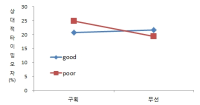
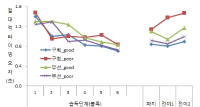
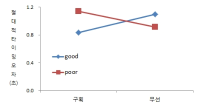
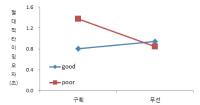
PURPOSE This study investigated differences in gaze entropy according to skill level and temporal occlusion in table tennis serve reception. METHODS Study participants were divided into a skilled group (n = 6) and a novice group (n = 6). The study task involved sitting in front of a monitor while wearing an eye tracker, watching 36 serve videos, and predicting whether the ball’s length would be short or long by pressing the "Top" (short serve) or "Bottom" (long serve) pad on the selection response pad. RESULTS Overall, the later the temporal occlusion level, the faster the reaction time and the higher the judgment accuracy. At temporal occlusion levels 2 and 3, skilled participants showed higher judgment accuracy than novices. Analysis of heatmap and gaze entropy revealed that novices exhibited visual search toward the ball across all temporal occlusion levels (T1, T2, T3) and had high gaze entropy. In contrast, skilled participants generally showed visual search to the racket area depending on the temporal occlusion level, with low gaze entropy at T1 and T2, and a tendency for increased gaze entropy at T3. CONCLUSIONS Compared to novices, skilled participants had lower gaze entropy and fixated more on the racket area when predicting table tennis serves. Similarly, novices focused more on the ball than on the racket. The study also proposed the value of using heatmap and Shannon entropy for this type of analysis.
PURPOSE This study aimed to investigate the occurrence of sports injuries among badminton national team candidates during training camps and to identify appropriate measures for players to effectively manage and respond to such injuries in the future. METHODS The participants consisted of 123 individuals who took part in national team candidate training camps for badminton in 2022 and 2023. Record sheets were utilized to document the athletes' thoughts and opinions related to exercise injuries during the training period. RESULTS Badminton national team candidates experienced exercise-related injuries in various areas, including the ankles, thighs, knees, hips, shoulders, and back. Female players had a higher incidence of lower body injuries compared to their male counterparts. Through interviews with players about these injuries, individualized approaches involving appropriate rest and training adjustments were found to be necessary; additionally, educating the players about rehabilitation strategies for exercise injuries is essential. CONCLUSIONS When conducting recreational training activities, it is important to avoid fostering excessive competitive attitudes. Additionally, if potential risks are present within the exercise environment, it is crucial to assess and address these with the utmost caution.
PURPOSE The main purpose of this study was to examine the difference in visual search strategies based on the skill level in success and failure cases in badminton short serves. METHODS To this end, six badminton experts (experience: more than 10 years) and six novices (less than 1 years) participated. The participants’ eye movement was recorded during each trial, and mean fixation duration, mean saccade amplitude, percentage of viewing time on each fixation location, final fixation duration, and gaze entropy were analyzed. RESULTS First, the mean fixation duration did not differ significantly, but the mean saccade amplitude increased when expert players failed to perform the serve successfully. Second, the percentage of viewing time on each location results showed that the overall viewing time was lower when the performance was unsuccessful, and the expert players fixated longer time viewing the net and space when they made a successful serve. Third, expert players showed longer QE than novice players when they made a successful serve. Finally, the gaze entropy results showed that expert players showed greater gaze entropy during successful performance, indicating that the gaze pattern was randomly distributed across trials. CONCLUSIONS When learning a badminton serve, we should fully recognize and explore the receiver’s location and external environment, and subsequently, before initiating serve movement, focus on the net or space between the receiver’s racquet and shoulders to make a more successful performance. In addition, we should make various patterns of the visual search strategy, rather than the fixed or consistent search strategy, to deceive receivers.
PURPOSE The quiet eye (QE) is defined as the final fixation time that is a specific target prior to initiating movement. This study aimed to identify the cause of QE in golf putting and to present an efficient practice method for improving putting skills. METHODS Thirty participants were randomly assigned to one of three groups. Each group practiced golf putting in different ways for two days. RESULTS The QE group showed a significant difference in putting scores, which was higher than that of the control group. The visual-occlusion group showed no difference compared to the other groups in terms of putting scores. The QE group showed a significant difference in terms of QE in the retention and competition tests compared to the pretest. The control group tended to have a slightly longer QE in competition tests compared to the pretest. The visualocclusion group showed no statistically significant difference in QE based on the period. All three groups had significantly longer swing times over the selected period. There was no significant difference in terms of the alpha power of the occipital lobe based on group and period. CONCLUSIONS The position of the visual-occlusion group became stable. However, the QE did not lengthen. The QE group had a longer QE. Furthermore, the control group that practiced with their eyes open tended to have longer QE. Therefore, QE may be related to visual-based cognitive processing rather than posturalkinematics. Finally, this study proved that QE practice is a more efficient method for novices in golf putting.
