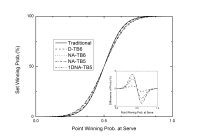
In this paper, effects on the match outcome of the various scoring methods frequently used in doubles tennis matches were analyzed using a simple probabilistic theory. It was assumed that the outcome of a single point depends on the server’s point-winning probability, which was assumed to be an independent event with an identical distribution for each point. It was found that the game-winning probability of the server’s team is greater than 0.5 - at times significantly higher - for server’s point-winning probability larger than 0.5, with the traditional game scoring method yielding the highest probability, followed by ‘one-deuce no-ad’ and then ‘no-ad rules’. For doubles matches between two ‘even-strength’ players on each team, which is essentially the same as singles matches, the order of the set-winning probability for the team with the first service game, as arranged in the order of the highest to the lowest, was: the traditional format (win-by-two-games), deuce games/tiebreak at six-games-all format, no-ad games/tiebreak at six-games-all format, one-deuce-no-ad games/tiebreak at five-games-all format, and finally no-ad games/tiebreak at five-games-all format, for the cases of point-winning probability larger than 0.5. In doubles matches involving teams with uneven average strengths or uneven partner skills, it was determined that the set-winning probability depends critically not only on the composition of the partners and service-game order but also on the scoring methods as well.