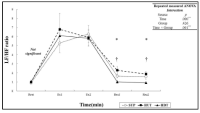
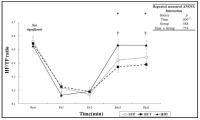
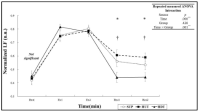
This study was aimed at investigating the effect of head-tilt angle on autonomic nerve modulation immediately after a single bout of exercise in twenty-three healthy young males(age 21.96 ± .4 yrs). Post-exercise HRV was measured on supine(SUP), -15°head-down tilt(HDT), and +15°head-up tilt(HUT) followed by 20 min aerobic exercise with moderate intensity(40% of VO2max). As results, heart rate recovery during post-exercise on each tilt angle(SUP vs. HDT vs. HUT) had no significant difference(p> .05). Also, there were no significant difference in time and nonlinear domain index of HRV. On spectral analysis; however, frequency domain index(HF, LF/HF ratio, HF/TP ratio, HF nu, LF nu) had significant difference(p< .05) on each tilt angle at recovery. Especially, PNS reactivation index (HF, HF/TP ratio, HF nu) had significant increase on HDT compared to HUT(p<. 05) while SNS activation index (LF/HF ratio, LF nu) had significant decrease on HDT compared to HUT(p<. 05). Furthermore, there were significant interaction between recovery time elapsed and each tilt angle (except for HF/TP ratio). In conclusion, -15°head-down tilt promotes the effective cardiac vagus nerve reactivation immediately after a single bout of aerobic exercise.