It has been known that β-alanine supplementation induce the increment of carnosine in vivo and was effective in delaying fatigue by buffering the hydrogen which was formed during exercise. This study was designed to investigate the effects of 4 weeks of β-alanine supplementation on physical fitness and blood lactate concentration in middle school soccer players. Nineteen middle school soccer players were randomly assigned to either one of two groups, i.e., β-alanine group (n=10) and placebo group (n=9). Subjects in β-alanine group consumed β-alanine 2 g/day during 1st and 2nd week, as well as 3 g/day during 3rd and 4th week, whereas subjects in placebo group consumed maltodextrin in the same manner. All subjects ate same menu and trained same amount at the same training camp during the intervention period. Body composition, aerobic capacity, anaerobic capacity, isokinetic function, and blood lactate concentration during maximal GXT were measured at pre- and post-test. Main results of the present test were as follows: 1) Fat mass and percent body fat decreased significantly in β-alanine group. 2) No significant changes were found in variables related to aerobic capacity in both groups. 3) Average power increased significantly in β-alanine group. 4) Isokinetic muscular endurance increased significantly in β-alanine group. 5) Blood lactate concentration did not change in eithet group; however, blood lactate concentration immediately after maximal GXT in β-alanine group tended to be increased more than placebo group. It was concluded that β-alanine supplementation would have positive effects for improvement of body composition, anaerobic capacity, and muscular endurance in middle school soccer players.
Purpose The purpose of this study was to examine the effects of 16 weeks’ combined exercise training on insulin resistance, inflammatory markers, oxidative stress, leukocyte telomere length, body composition, and daily living fitness in elderly women with type 2 diabetes mellitus (DM). Methods Twenty-eight participants were randomly assigned into one of two groups, i.e., exercise training group (EX: n=14) and control group (CON: n=14). Subjects in EX participated in 3 sessions of 60 min-combined exercise for 16 weeks, whereas subjects in CON were asked to maintain their normal life pattern during the same period. The variables regarding insulin resistance, inflammatory markers, oxidative stress, leukocyte telomere length, body composition, and daily living fitness were measured and compared between two groups as well as between pre-post test utilizing a repeated two-way ANOVA. Results Main results were as follows: 1) Fasting plasma insulin and HOMA-IR tended to decrease in EX, whereas increased significantly in CON. 2) IL-6, TNF-α, hs-CRP decreased in EX, but the changes were not statistically significant. 3) MDA increased significantly and GPx decreased significantly in both EX and CON. 4) Leukocyte telomere length increased significantly in EX. 5) Fat-free mass increased in EX, whereas fat mass and percent body fat decreased significantly in EX. 6) Arm curl, chair stand, sit & reach, tandem test, 10m walking speed, and up & go improved significantly in EX. Conclusion It was concluded that the combined exercise for 16 weeks had a positive effect on improving insulin resistance, increasing leukocyte telomere length, as well as enhancing body composition and daily living fitness in elderly women with type 2 diabetes.
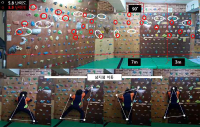
[Purpose] The study was designed to examine the effects of a 10-week sports climbing training on body composition and surrogate indices of major lifestyle disease in obese elderly women. [Methods] Twenty elderly women, whose percent body fat was over 35%, were randomly assigned into one of two groups, i.e., sports climbing training group (TR: n=10) and control group (CON: n=10). The subjects in TR completed sports climbing training program with 5.8 and 5.9 of difficulty, at 11-13 of ratings of perceived exertion (RPE), 60 min/session, three sessions/wk for 10 weeks. Independent variables regarding body composition and major lifestyle disease, i.e., hypertension, dyslipidemia, and atherosclerosis, were measured and compared between two groups as well as between two tests simultaneously using a repeated two-way ANOVA. [Results] Regarding physique and body composition, there were significant interactions between group and test in body weight, body mass index, fat mass, and percent body fat. These variables decreased significantly in TR. 2) Regarding indices of hypertension, systolic blood pressure, diastolic blood pressure, mean arterial pressure, and pulse pressure decreased significantly in TR. Regarding indices of dyslipidemia, triglyceride decreased significantly in TR. Regarding indices of atherosclerosis, TG/HDL-C ratio decreased significantly in TR. [Conclusions] It was concluded that the 10-week sports climbing training would be beneficial for reduction of body fat despite its’ influence on fat-free mass was limited, and would also contribute on improving surrogate indices of hypertension, dyslipidemia, and atherosclerosis in obese elderly women. Future research investigating the effects of various period, intensity, duration, and frequency of sports climbing training would be warranted.
Purpose The study was designed to compare physical fitness, indices of lifestyle disease, and biochemical property of muscle according to sarcopenia and obesity in elderly women. Methods One hundred elderly women were alloted to one of four groups, i.e., sarcopenia+obesity (SO: n=20) group, sarcopenia (S: n=20) group, obesity (O: n=29) group, and normal (N: n=31) group. Criterion for sarcopenia was 'appendicular skeletal muscle mass (ASM)/height2<5.4 kg/㎡', and criterion for obesity was 'percent body fat>35%'. Dependent variables regarding physical fitness, lifestyle disease, and biochemical property of muscle were measured and compared among four groups. Results 1) Regarding daily living fitness, grip strength, upper arm flexion, sit-and-reach, up and go, and VO2max in SO group and S group were significantly lower than N group. Regarding isokinetic function, peak torque and average power in SO group and S group were significantly lower, and relative values to body weight in SO group and O group were significantly lower than N group. 2) Regarding hypertension, resting HR and RPP in SO group and O group were significantly higher than S group and N group. Regarding diabetes mellitus, fasting plasma glucose and HOMA-IR in SO group and O group were significantly higher than S group and N group. Regarding hyperlipidemia, HDL-C in SO group and O group were significantly lower than S group and N group. Regarding atherosclerosis, TC/HDL-C ratio and LDL-C/HDL-C ratio in SO group and O group were significantly higher than S group and N group. 3) Regarding biochemical property of muscle, IL-6 in SO group and O group were significantly higher than S group and N group. Conclusion It was concluded that physical fitness was declined in sarcopenia elderly, and that relative value of isokinetic function, indices of lifestyle disease, and inflammation markers were deteriorated in obesity elderly. Especially, the decline and deterioration of physical fitness and indices of lifestyle disease were even more severe in the elderly who had the both status. Therefore, the efforts should be made to prevent and improve sarcopenia and/or obesity.
This study was designed to investigate the effects of increment of physical activity for 12 weeks through aerobic exercise training or change from own vehicle to public transportation for commuting on physical fitness, insulin resistance, inflammatory markers, and liver function in middle-aged men. Forty-four subjects, aged 30-50 yrs, were randomly assigned to either one of three groups, i.e., aerobic exercise training group (TR: n=14), change to public transportation group (PT: n=15), or control group (CON: n=15). Subjects in TR performed aerobic exercise for 30 min per sessions, three sessions per week, subjects in PT changed from their own vehicle to public transportation for commuting, and subjects in CON maintained their life patterns during the same intervention period. Physical fitness, insulin resistance, inflammatory markers, and liver function were measured at pre- and post-test, and the data were analyzed by repeated two-way ANOVA. Main results of the present study were as follows: 1) All variables related to physical fitness improved significantly in TR. Right grip strength, standing long jump, side step test, and sit-and-reach improved significantly in PT. 2) Although there were no significant changes in all variables related to insulin resistance, the variables tended to be improved in TR and PT. 3) TNF-α decreased significantly in TR and PT. IL-6 and CRP tended to be improved in TR and PT; however, the changes did not reach statistical significant level. 4) ALT decreased significantly in PT. AST and γ-GT tended to be improved in TR and PT; however, the changes did not reach statistical significant level. It was concluded that the 12 weeks of change to public transportation as well as aerobic exercise training would be beneficial for physical fitness and inflammatory markers. These interventions also would be possible to improve insulin resistance and liver function. The increment of physical activity through change from own vehicle to public transportation was found to be equally beneficial for health promotion compared to aerobic exercise.
