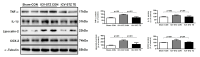
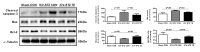
The purpose of this study was to explore the effects of 6-week treadmill exercise on inflammation and neuronal cell death in the hippocampus of intracerebroventricular (ICV) streptozotocin (STZ)-injected Alzheimer's disease (AD) rats. The experimental animals were divided into Sham-CON group (n=10), ICV-STZ CON group (n=10) and ICV-STZ TE group (n=10). The treadmill exercise was conducted for 30 minutes a day, 5 days a week, for 6 weeks. First, in a water maze test, it turned out that the time and distance of finding an escape platform significantly increased in the ICV-STZ CON group as compared to those in the Sham-CON group. In contrast, it turned out that the time and distance of finding the escape platform significantly decreased in the ICV-STZ TE group in which the treadmill exercise was carried out as compared to those in the ICV-STZ CON group. The expression of marker of astrocytes, Glial Fibrillary Acidic Protein (GFAP) increased in the ICV-STZ CON group as compared to that in the Sham-COM group, but that in the ICV-STZ TE group decreased as compared to that in the ICV-STZ CON group. Regarding inflammatory reactions, it turned out that the expressions of TNF-α, IL-1β, Lipocalin-2 and COX-2 increased in the ICV-STZ CON group as compared to those of the Sham-CON group, but it turned out that those of the ICV-STZ TE group decreased as compared to those of the ICV-STZ CON group. Regarding neuronal cell deaths, the expressions of caspase-3 and Bax increased in the ICV-STZ CON group as compared to the Sham-CON group, but it turned out that the expression of Bcl-2 decreased, and the neuronal cell deaths increased. However, it turned out that the neuronal cell deaths decreased in the ICV-STZ TE group in which the treadmill exercise was carried out as compared to that in the ICV-STZ CON group. Therefore, it turned out that the treadmill exercise showed positive effects on improving cognitive ability by reducing inflammatory reactions and inhibiting neuronal cell deaths in the rats with AD. In other words, aerobic exercise like treadmill exercise can be applied as an effective alternative to improve symptoms of AD.


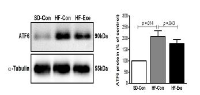
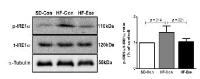
This study was to performed to the effect of 8-week endurance exercise influences on body weight, glucose tolerance and ER-stress in soleus of 16weeks Rats fed High-Fat diet. Rats were randomly assigned to 3 group; (1)Sprague-Dawley Control diet (SD-Con/n=4), (2)High-Fat diet Control (HF-Con/n=4), (3)High-Fat diet Exercise (HF-Exe/n=4). Exercise group ran on the treadmill for 30min/day at the level of 21m/min for 5days/week during 8weeks. Results showed that body weight and glucose tolerance of the HF-Con group was remarkably increased(p<.05) compared to other groups. However, HF-Exe group significantly decreased body weight and glucose tolerance compared to HF-Con group. Moreover, level of GRP78, ATF6, PERK and IER1⍺, which are main proteins of ER-stress were significantly increased in HF-Con group higher than other group, whereas HF-Exe group significantly decreased the expression of GRP78, ATF6, PERK and IER1⍺. Taken together, these finding suggested that the reduction of the body weight, glucose tolerance and unfolded protein response by treadmill exercise may represent a positive adaptation protecting against high-fat diet-induced ER stress.