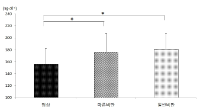
This study was designed to compare physical fitness, blood lipids, and insulin resistance according to body mass index (BMI) and percent body fat (%BF) in 20s females. Sixty women, aged 20-29 yrs, volunteered to participate in the study as subjects. There were three groups, i.e., normal group (BMI < 24 kg·m-2 and %BF < 25%; n = 25), normal weight obese group (BMI < 24 kg·m-2 and 28% < %BF < 40%; n = 22), and obese group (BMI > 26 kg·m-2 and 30% < %BF < 40%; n = 13). Physical fitness, blood lipid profiles, and surrogate indices of insulin resistance were measured and compared among three groups. Main results of the present study were as follows: 1) There were significant differences in all variables regarding body composition among three groups. All values were lowest in normal group and highest in obese group. 2) There was significant difference in sit-and-reach among three groups, whereas no significant differences were found in other variables regarding physical fitness among three groups. 3) There were significant differences in all variables regarding blood lipids among three groups. In particular, total cholesterol (TC), low density lipoprotein cholesterol (LDL-C), TC/HDL-C ratio, and LDL-C/HDL-C ratio were significantly higher in normal weight obese group than normal group. 4) There were significant differences in all variables regarding insulin resistance among three groups. Fasting plasma glucose and HOMA-IR were lowest in normal group and highest in obese group. It was concluded that there would be abnormal blood lipid profiles and insulin resistance in even normal weight obese individuals as well as general obese individuals in 20s females.

This study was designed to investigate the effects of increment of physical activity for 12 weeks through aerobic exercise training or change from own vehicle to public transportation for commuting on physical fitness, insulin resistance, inflammatory markers, and liver function in middle-aged men. Forty-four subjects, aged 30-50 yrs, were randomly assigned to either one of three groups, i.e., aerobic exercise training group (TR: n=14), change to public transportation group (PT: n=15), or control group (CON: n=15). Subjects in TR performed aerobic exercise for 30 min per sessions, three sessions per week, subjects in PT changed from their own vehicle to public transportation for commuting, and subjects in CON maintained their life patterns during the same intervention period. Physical fitness, insulin resistance, inflammatory markers, and liver function were measured at pre- and post-test, and the data were analyzed by repeated two-way ANOVA. Main results of the present study were as follows: 1) All variables related to physical fitness improved significantly in TR. Right grip strength, standing long jump, side step test, and sit-and-reach improved significantly in PT. 2) Although there were no significant changes in all variables related to insulin resistance, the variables tended to be improved in TR and PT. 3) TNF-α decreased significantly in TR and PT. IL-6 and CRP tended to be improved in TR and PT; however, the changes did not reach statistical significant level. 4) ALT decreased significantly in PT. AST and γ-GT tended to be improved in TR and PT; however, the changes did not reach statistical significant level. It was concluded that the 12 weeks of change to public transportation as well as aerobic exercise training would be beneficial for physical fitness and inflammatory markers. These interventions also would be possible to improve insulin resistance and liver function. The increment of physical activity through change from own vehicle to public transportation was found to be equally beneficial for health promotion compared to aerobic exercise.
