This study was designed to examine the effects of 12 weeks of resistance exercise training on physique, body composition, insulin resistance, and blood lipid profiles in 20s normal weight obese females. Sixteen females were randomized into one of following two groups: resistance training group (RT group; n=8) and control group (CON group; n=8). Subjects in RT group completed 12 weeks of resistance exercise training for three times/wk, and subjects in CON group were asked to maintain their normal life pattern during the same intervention period. Data were analyzed using two-way repeated measures ANOVA with post hoc test. Main results of the present study were as follows: 1) Body weight, BMI, waist circumference, hip circumference, WHR, and WHtR decreased significantly in RT group. 2) All variables regarding body composition did not change in both groups; however, fat mass was tended to decrease more in RT group than CON group. 3) Fasting plasma glucose decreased significantly in both groups, whereas other variables regarding insulin resistance did not change significantly in both groups. 4) All variables regarding blood lipids did not change significantly in both groups. Results indicate that 12 weeks of resistance exercise training was beneficial in physique and body composition; however, it was not beneficial in insulin resistance and blood lipid profiles in 20s normal weight obese females. Future research including normal weight obese subjects with higher age would be warranted to elucidate more clearly the effects of resistance exercise training on metabolic status.
The purpose of this study was to investigate the effects of 8 weeks of aerobic training and resveratrol supplementation on a body composition, physical fitness, insulin resistance, liver function, blood pressure, and heart rate. Fifty-one elderly women were randomly assigned to aerobic training group (EX: n=12), resveratrol supplementation group (R: n=13), combined aerobic training and resveratrol supplementation group (EX+R: n=12), and control group (CON: n=14). The subjects in EX group exercised three sessions per week, 40 minutes per session for 8 weeks, the subjects in R group took 500 mg of resveratrol per day for 8 weeks, and the subjects in EX+R group received both treatments. The subjects in CON group were asked to maintain normal daily life pattern without any treatment for the same period of intervention. Body composition, physical fitness, insulin resistance, liver function, blood pressure, and heart rate were measured at pre- and post-test and the data were compared among groups and between tests by utilizing two-way ANOVA with repeated measures. Main results of the present study were as follows: 1) Physique and body composition did not change significantly in all groups. 2) Muscular endurance increased significantly in EX+R group, whereas the other physical fitness-related variables showed no significant changes in all groups. 3) Fasting glucose, fasting insulin, HOMA-IR, and HbA1c tended to be improved in EX+R group. 4) AST, ALT, and γ·GT showed no significant changes in all groups. 5) Systolic blood pressure and diastolic blood pressure increased significantly in CON group. Heart rate tended to be decreased in EX+R group and EX group. It was concluded that the 8 weeks of aerobic training and resveratrol supplementation had positive effects on muscular endurance, insulin resistance, and blood pressure in T2DM elderly women. Research investigating the effects of a longer period of aerobic training and resveratrol supplementation on the same variables would be warranted in the future.
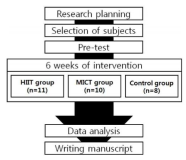
The primary purpose of this study was to investigate the effects of 6 weeks of high-intensity intermittent training (HIIT) and moderate-intensity continuous training (MICT) under relatively equal energy expenditure on body composition, aerobic capacity, cardiovascular function, insulin resistance, and blood lipid profiles in 20s overweight males. Twenty-nine males were randomized into one of the following groups: HIIT group (n=11), MICT group (n=10), and control group(n=8). Subjects in HIIT group completed 6 weeks of training for 25 min/sessions, three times/wk, and subjects in MICT group exercised for 33 min/session to equalize the energy expenditure with HIIT group. Subjects in control group were asked to maintain their normal life pattern during the same intervention period. Data were analyzed using two-way repeated measures ANOVA with post hoc test. Main results of the present study were as follows: 1) Body weight, BMI, fat mass, and WHR decreased significantly in HIIT group. 2) VO2max, VEmax, and time to exhaustion increased significantly in HIT group. 3) SBP decreased significantly in HIIT group and HRrest was tended to decrease in HIIT. 4) Fasting plasma insulin and HOMA-IR were tended to decrease in HIIT, but the changes failed to reach the statistically significant level. 5) HDL-C and TG were tended to improve in HIIT, but the changes failed to reach the statistically significant level. Results indicate that high intensity intermittent exercise training is more beneficial in aerobic capacity and cardiovascular function. It was also suggested that 6 weeks of aerobic exercise training in either high intensity intermittent or moderate intensity continuous was not sufficient enough to induce changes in body composition, insulin resistance and blood lipid profiles.
The primary purpose of the study was to compare cardiovascular function, mental health indices, stress-related variables according to body mass index (BMI) and percent body fat (%BF) in 20s females. Sixty-eight women, aged 20-29 yrs, participated in the study as subjects. There were three groups, i.e., normal group (BMI<24 kg·m-2 and %BF<25%; n=25), normal weight obese group (BMI<24 kg·m-2 and 28%<%BF<40%; n=19), and obese group (BMI>26 kg·m-2 and 28%<%BF<40%; n=24). Cardiovascular function, mental health indices, stress-related blood variables were measured and compared among three groups. Main results of the present study were as follows: 1) SBP, DBP, mean arterial pressure, and RPP were significantly higher in obese group than normal group. 2) There were no significant differences in mental health indices among three groups. 3) Fasting plasma insulin, fasting plasma glucose, and CRP were significantly higher in obese group than normal weight obese group and normal group. It was concluded that there would be abnormal cardiovascular function, insulin resistance, and inflammation in general obese individuals in 20s females, not normal weight obese and normal individuals.
