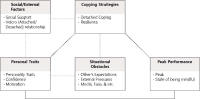
[Purpose] This study was designed to explore Yuna Kim’s psychological strengths and the contextual factors, which led her to obtain the gold medal and the reflection of peak performance and preparation at the 2010 Olympics. It was hoped that by sharing the experience of one of the top athletes, other athletes would learn from her and prepare themselves better for Olympics in the future. [Methods] A case study method was applied with a qualitative approach. To obtain the purpose of the study, five in-depth interview sessions including introductory and member checking procedures were conducted. The interviews were recoded and transcribed verbatim, and content analysis was used to inductively analyse the data. [Results] The four general dimensions that were discovered in the results included Social-external Factors, Personal Traits, Coping Strategies, and Peak Performance. The social-external factors consisted of social support and attached/detached relationships while personal traits were personality traits, confidence and motivation. Coping strategies to overcome external and situational pressures were detached coping and resilience whereas peak performance was reflected on flow and the state of being mindful. [Conclusion] In conclusion, Yuna Kim’s strength was parallel with the previous research on the top athletes and other findings such as adaptive perfectionism and a sense of rivalry in the research were discussed.
Purpose The purpose of this study was to develop an effective college life adaptation program for freshman student-athletes. Methods A total of 160 student-athletes and 5 experts agreed to participate in this study. Four procedures were followed in this study: the needs assessment, the preliminary program development, and the application of the program. For the needs assessment, in-depth interviews were conducted, and the data were analyzed using an inductive reasoning process. Results The results of the needs investigation showed seven need factors and four interruption factors for college life adaptation. In addition, three need factors based on experience and seven interruption factors based on experience were found. The preliminary program was developed based on the needs assessment through the expert meeting, and the program consisted of four stages. Each stage consisted of three sessions, and each session contained a specific topic. The program was provided to nine freshman student-athletes in two months. As a result, the final program which consisted of four stages and thirteen sessions was developed after the reinforcement process based on evaluation of the preliminary program was conducted. Conclusions It is concluded that, the program is able to be expected to help them to understand their roles, have a better sense of responsibility and improve their self-esteem. Therefore, coaches and mental performance consultants should provide the college life adaptation program for freshman student-athletes to reduce their stress and have a better college life.
