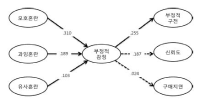
The ever-increasing golf club market made difficult and brought confusion to most of amateur golfers to differentiate and choose suitable clubs for them. Therefore, the purpose of study was to examine how consumer confusion proneness affects consumer’s negative emotion, negative word of mouth, trust and decision postponement, during the process of purchasing golf clubs. 450 questionnaires were distributed to recreational golfers in 6 different golf-driving rages and 4 golf courses located in Seoul, Gyeonggi and Gangwon area with a return rate of 98.4% (n=443). Total of 432 questionnaires were used for data analyses with PASW 18.0 and AMOS 18.0. The results of the study are as follow. First, all of the subordinate factors of consumer confusion proneness had a significant effect on the consumer’s negative emotion. Second, consumer’s negative emotion had a significant effect on negative word of mouth. Third, consumer’s negative emotion had a significant effect on trust. Fourth, consumer’s negative emotion had no significant effect on purchase postponement.
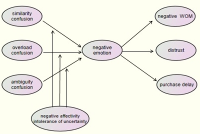
Purpose The purpose of this study was to identify how the three variables of consumer confusion proneness affect consumers' negative emotion, word of mouth, trust and decision postponement during the process of purchasing golf club. Futhermore, this study looked through the moderating effect of the personal characteristics in the relation between consumer confusion proneness and negative emotion. Method A total of 850 questionnaires were used for data analyses(i.e., frequency analysis, confirmatory factor analysis, structural equation modeling) with PASW 18.0 and AMOS 18.0. The results of the study are as follow. Results First, all of the subordinate factors of consumer confusion proneness had a significant effect on the consumer's negative emotion. Second, consumer's negative emotion had a significant effect on negative WOM. Third, consumer's negative emotion had no significant effect on distrust. Fourth, consumer's negative emotion had a significant effect on decision postponement. Fifth, the moderating role of negative effectivity partially had a significant influence in a relation ship between confusion proneness and negative emotion. Sixth, the moderating role of intolerance of uncertainty had a significant influence in a relation ship between confusion proneness and negative emotion. Conclusion The results of this study contributed to provide fundamental information on over all golf industry as in service providing point of view as well as development and application relate to it.
PURPOSE This study aimed to identify the decision-making process for consumers participating in sports centers based on an extended goal-directed behavior model (EMGB), and to provide empirical data for establishing effective operation strategies for sports centers, including additional risk perception of consumers during pandemic. METHODS A total of 446 surveys were used as the final sample. For data analysis, SPSS 21.0 and AMOS 21.0 were used for frequency analysis, correlation analysis, confirmatory factor analysis, and structural equation model analysis. RESULTS Except for hypothesis 2 and 9, all of the hypothesis were chosen. CONCLUSIONS The findings suggested that extended goal-oriented behavior models can increase consumers' cognitive and emotional factors through emotional aspirations, suggesting that a lower risk perception of COVID19 increases their desire to participate in sports centers, and provides academic fundamental data on how to increase and activate sports centers.
