PURPOSE This study investigated the associations among sociodemographic factors, physical activity (PA) types and frequencies, and various mental health indicators among adolescents. METHODS Participants included 45,006 adolescents who answered the online 2024 Korea Youth Risk Behavior Survey. Mental health– related variables, such as perceived sadness and despair, suicidal ideation, perceived loneliness, and generalized anxiety disorder diagnosis, were analyzed in relation to sociodemographic factors. Associations with PA type and frequency were examined as well. The data underwent simple and multiple logistic regression analyses, and odds ratios with 95% confidence intervals were calculated. RESULTS First, sadness and despair perceptions significantly differed by gender, academic achievement, residence type, student classification, and study time. Adolescents who performed low-intensity PA ≥4 days per week and high-intensity PA 1–3 days or ≥4 days per week had significantly lower odds of experiencing sadness and despair. Second, suicidal ideation was significantly associated with gender, academic achievement, socioeconomic status (SES), residence type, urban vs. rural classification, student classification, and study time. Adolescents who engaged in low-intensity PA ≥4 days per week and high-intensity PA 1–3 days or ≥4 days per week displayed a significantly lower likelihood of suicidal ideation. Third, loneliness perceptions significantly varied by gender, academic achievement, economic SES, type of residence, urban vs. rural classification, student classification, and study time. Engaging in low-intensity PA ≥4 days per week was significantly associated with lower odds of perceived loneliness. Finally, the diagnosis of generalized anxiety disorder was significantly associated with gender, academic achievement, SES, residence type, student classification, and study time. Performing low-intensity PA ≥4 days per week and high-intensity PA 1–3 days or ≥4 days per week was significantly linked to a lower likelihood of a generalized anxiety disorder diagnosis. CONCLUSIONS Regular PA is an effective strategy for promoting adolescent mental health; specifically, appropriate exercise intensity and supportive environments for adolescents’ PA play a critical role in improving their mental health.

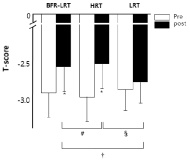
Purpose The purpose of this study was to investigate the effects of low-intensity resistance training with blood flow restriction on serum VEGF, bone markers and bone mineral density in elderly women. Methods The subjects were divided into three groups: low-intensity resistance training with blood flow restriction(BFR-LRT, n=8); high intensity resistance training(HRT, n=8); low- intensity resistance training (LRT, n=5). Both the BFR-LRT and LRT groups worked out knee extension and leg curl exercises at 20% of each estimated one-repetition maximum(1RM) and HRT group worked out knee extension and leg curl exercises at 70% of each estimated 1RM 3 days per week for 12 weeks. Results As a result after 12 weeks, serum VEGF level have increased significantly among BFR-LRT group compared to HRT and LRT groups. Serum Bone ALP level have increased significantly among BFR-LRT and HRT groups compared to LRT group. Calcaneus BMD have increased significantly among BFR-LRT and HRT groups compared to LRT group. Conclusions In conclusion, despite using low-intensity load, BFR-LRT is a efficient training alternative to HRT for improving bone metabolism in older women.