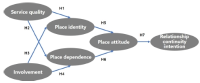
Purpose The purpose of this research is to empirically analyze the relationship between a indoor swimming pool on service quality and involvement, place attachment, place attitude & relationship continuity intention through structural equation model analysis. Methods For this purpose, this study set 241 members at the five private indoor swimming pools located in Seoul as the research subjects. In an effort to verify the proposed structural model, this study used IBM SPSS WIN Ver. 21.0 and AMOS 18.0. Results As a result, First, the results showed that service quality had a positive effect on place identity. Second, it was found that service quality had a positive effect on place dependence. Third, the results showed that involvement didn't have a positive effect on place identity. Fourth, involvement didn’t have a positive effect on place dependence. Fifth, the results showed that place identity had a positive effect on place attitude. Sixth, the results showed that place dependence had a positive effect on place attitude. Seventh, place attitude was found to had a positive effect on relationship continuity intention.

Purpose The purpose of this study is to empirically inquire into the relationship between a indoor swimming pools employee’s group cohesiveness, swimming pool identification & communication and job satisfaction, customer orientation, long-term orientation, and positive word of mouth through structural equation model analysis. Methods For this purpose, For this purpose, the survey targeted 221 workers working at 10 swimming pools in Seoul for over three months. For sampling method, convenience sampling method was used, while the questionnaire was self-administered. In an effort to verify the proposed structural model, this study used IBM SPSSWIN Ver. 21.0 and AMOS 18.0. Results First, group cohesiveness, swimming pool identification & communication has positive influence on the job satisfaction. Second, job satisfaction has positive influence on the customer orientation. Third, job satisfaction has positive influence on the positive long-term orientation. Fourth, customer orientation has positive influence on the positive word of mouth. Fifth, long-term orientation has positive influence on the positive word of mouth.
