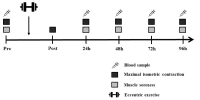
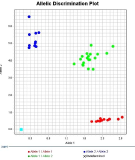
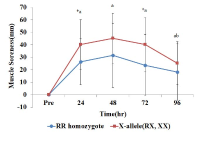
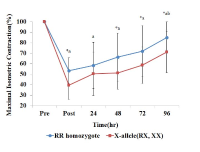
[Purpose] The purpose of this study was to examine the change of muscle damage markers after maximal eccentric exercise and to verify the difference of recovery according to ACTN3 gene polymorphism. [Methods] Fifty healthy males participated in this study. Subjects performed 25 times/1 set (total 2 set) maximal eccentric contractions of the elbow flexor muscles on a modified preacher curl machine with a between-sets rest time of 5 min. Maximal isometric contraction (MIC) was measured 6 times (pre, post, after 24 h, 48 h, 72 h and 96 h). Muscle soreness (SOR) was measured 5 times (pre, after 24 h, 48 h, 72 h and 96 h). Blood samples were collected 5 times (pre, after 24 h, 48 h, 72 h and 96 h). ACTN3 gene polymorphisms were identified using polymerase chain reaction (PCR). Data were analyzed using a 2-way repeated measure ANOVA and post hoc Bonferroni test. [Results] Analysis of ACTN3 gene polymorphism revealed the following distribution: 22% RR (n=11), 50% RX (n=25), and 28% XX (n=14). Individuals were classified into the RR homozygote group (n=11) and the X-allele group (n=39). MIC showed a significant difference between groups and interaction (p<.05). The groups differed significantly in MIC at 48 h, 72 h, and 96 h after exercise and the X-allele group decreased more than the RR homozygote group. The groups differed significantly in muscle soreness and interaction (p<.05). SOR in the X-allele group was significantly higher than in the RR homozygote group at 24 h after exercise. Although blood CK activity was lower in the RR homozygote group than in the X-allele group, but there was no significant difference between the groups (p>.05). [Conclusion] The RR homozygote group showed lower muscle strength reduction rate, muscle soreness and blood CK activity than the X-allele group. This indicates that RR individuals have a lower risk of exercise-induced muscle damage than those with an X-allele.
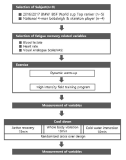
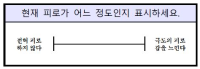
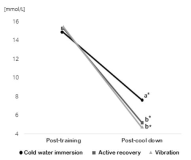
[Purpose] The purpose of this study was to examine the effect of recovery methods comparing with change ratio in Lactic acid(LA), Heart rate(HR), VAS(Visual analogue scale) on recovery patterns after field training(FT) in Korea National bobsleigh and skeleton players. [Methods] The tests were conducted for 3 times at a one-week interval as an experimental design within the same subjects(n=9), observed change ratio in LA, HR, VAS through applying Active recovery(AR), Whole body vibration(WBV) & Cold water immersion(CWI) after FT. [Results] The results were summarized as follows: The alteration of ratio in LA, HR, VAS decreased significantly after applying the three recovery patterns(p<.01). The difference between the groups showed that the reduction in lactic acid according to active recovery and whole-body vibration was higher than cold water immersion(p<.01). [Conclusion] In conclusion, although active recovery was more effective than static recovery, there was a significant effect of the three recovery methods in this study on reducing a fatigue in bobsleigh & skeleton players. Therefore, it would be considered to improve the performance of athletes when these methods apply for them depending on situations and environments.