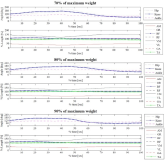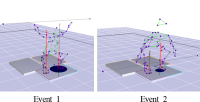
Purpose The purpose of this study was to identify the lower extremity muscles length change according to the increase of the weight during snatch. Also, through the muscle contraction velocity analysis, it is necessary to identify muscles that require rapid muscle contraction. Methods The subjects were 10 national weight-lifters. Their mean age was 29 ± 3.84 yrs, body weight 71.3 ± 16.04 kg, height 1.63 ± 0.07 m, and the highest recorded height 128 ± 36.30 kg. Experiments were performed during the snatch to 70%, 80%, and 90% of the individual highest records. The analysis variables were the lower extremity angle, angular velocity, muscle length and muscle contraction velocity and were calculated by biomechanical modeling. Statistical analysis was performed with a repeated measure with one-way ANOVA to analyze the difference between the increase weight (70%, 80%, 90% of peak) and the dependent variable (angel, angular velocity, muscle length and muscle contraction velocity). Results According to the results of the study, there was no statistical difference in angle, angular velocity and muscle length with increasing weight. However, in the comparison of the muscle length, muscle length of the vastus medialis, vastus lateralis, biceps femoris, rectus femoris were statistically higher than other muscles. Also muscle contraction velocity of the rectus femoris, biceps femoris, vastus medialis, vastus lateralis, rectus femoris were statistically higher than other muscles. Conclusion In the snatch, the dominant muscles were the muscles around the femur, and the co-contraction of biceps femoris and great adductor muscles would contribute to improve the performance.