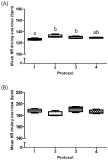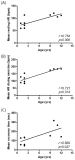
Purpose The purpose of this study was to investigate changes of the cardiovascular system by comparing heart rate (HR) and blood responses to exercise in younger and older adult dogs and to verify the value of dogs as aging model in exercise science research. Methods A total of 11 healthy beagles were divided into 2 groups according to age: younger adult dogs (1~2 years old, 7 animals) and older adult dogs (9~11 years old, 4 animals). Each animal exercised on the treadmill for 25 minutes, twice a week, and for 4 weeks. The exercise intensity was gradually increased by applying four different protocols. Resting HR, HR during exercise, and HR recovery time were determined as HR parameters. Biochemical analysis was performed on blood samples. The independent Student’s t-test and one-way ANOVA were used to analyze the mean difference of each variable. The associations between age and HR parameters were determined using Spearman‘s analysis. Results Older adult dogs showed higher HRs during rest and exercise than younger adult dogs. HR recovery time was significantly longer in older adult dogs than in younger adult dogs. A strong positive relationship was observed between beagles’ age and resting HR, HR during exercise, and HR recovery time, respectively. The heart rate response to the treadmill exercise was similar between the 1st week and 4th week in younger and older adult dogs. Exercise significantly reduced the white blood cell level in older adult dogs and increased the alkali phosphatase level in younger adult dogs. Conclusions The results of this study demonstrated that short-term treadmill exercise may have a positive effect on the aerobic capacity, inflammation, and bone formation, suggesting that dogs are valuable as aging model in exercise science research.