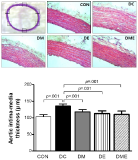
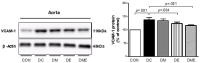
Purpose The purpose of this study was to investigate the effect of treadmill exercise and MitoQ treatment on NADPH oxidase, antioxidation and vascular function-related factors in aortic of D-galactose-induced aging rats. Methods To induce the animal model of aging, D-galactose was diluted in saline, and a dose of 100mg /kg was intraperitoneally injected into Sprague-Dawley rats once a day for a total of 10 weeks. Rats were divided into five groups: Control group (CON, n=9), D-galactose control group (DC, n=9), D-galactose+MitoQ group (DM, n=9), D-galactose+Exercise group (DE, n=9), D-galactose+MitoQ + Exercise group(DME, n=9), and treadmill exercise was conducted for 5 days/week during 8 weeks with gradual increase of intensity. MitoQ treatment was intraperitoneally injected at a concentration of 100μM/kg twice a week for 8 weeks during the research period. Results The result showed that treadmill exercise and MitoQ treatment decreased the expression of NADPH oxidase level and increased antioxidant enzyme such as SOD-2, catalase. It lead to positive effects such as increasing the level of eNOS, a protein involved in vascular function while decreasing the level of VCAM-1. In addition, as a result, it showed the structurally reduced intima-media thickness. Conclusions It can be concluded that treadmill exercise and MitoQ treatment are effective in ameliorating and treating vascular dysfunction resulting from aging.
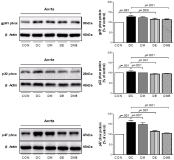
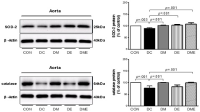
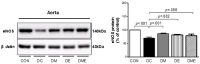
PURPOSE This study aimed to prove the mediator effect of skill level on participation frequency and injury level of leisure sports players with the highest injury rate. METHODS Raw data of the “2019 Sports Safety accident data” conducted by the Korea Sports Safety Foundation were used for this study. We analyzed 857 leisure sports players participating in events with the top four highest injury rates (Basketball, Soccer, Baseball/Softball, Foot Volleyball). Frequency, descriptive statistics, and correlation analyses using SPSS version 27.0 and Process macro model 4 were employed for analysis. RESULTS The results regarding participation frequency, injury severity, and skill level among recreational athletes are as follows. First, a positive correlation was established between the participation frequency of recreational athletes and their skill levels. Second, the correlation between participation frequency and injury severity was observed only in soccer and basketball. Third, skill level plays a mediating role in the relationship between participation frequency and injury level. The results indicate that as the participation frequency among leisure sports players who participate in ball sports with a high injury rate increases, this affects the degree of injury. CONCLUSIONS Skill level appears to play a mediating role in the relationship between participation frequency and injury level. Based on the results, we recommend safety education not only on the relationship between participation frequency and injury level, but also the intermediary role of skill level.
