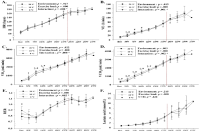
Purpose The purpose of this study was to determine the effectiveness of six-weeks intermittent hypoxic training at 3,000 m hypobaric hypoxic condition on aerobic and anaerobic exercise capacity in competitive swimmers. Methods South Korean swimmers (n=20) were randomly assigned into training at sea-level (n=10, intermittent normoxic training group; INT) and training at 526 torr corresponding to 3,000 m hypobaric hypoxic condition (n=10, intermittent hypoxic training group; IHT). The participants completed an aerobic continuous treadmill training (30 min) within 80%HRmax and anaerobic interval bicycle training (10 times; 2 min of exercise and 1 min of rest) for 30min within 90%HRmax in each environment. We compared their aerobic and anaerobic exercise capacity before and after six-weeks of training. Exercise frequency was 1 hour, 3 days per a week, and during 6 week. Results In aerobic exercise capacity, PWC at 75%HRmax, estimated VO2 max, and exercise time were increased by training in only the IHT group. Estimated VO2 at 75%HRmax was increased by training in both groups, but presented a larger increase tendency in the IHT group compared with the INT group. In anaerobic exercise capacity, peak anaerobic power and fatigue index were increased by training in only the IHT group. Blood lactate level after wingate test were decreased by training in both groups, but the IHT group have a lower blood lactate level in after training compared with the INT group. Conclusion In our study, we did not measure to various dependent variables for support to enhancement of aerobic and anaerobic exercise performance. However, these results showed that the IHT method may be effective in improvement of exercise performance in competitive swimmers who participates in a variety of events from short to long distance.
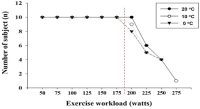
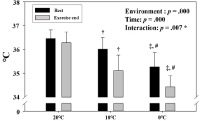
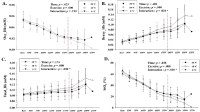
Purpose This study aimed to investigate the effects of acute cold stress (10℃, 0℃) compared with ordinary temperature (20℃) on exercise performance and physiological response at rest and during exercise. Methods A total of 10 healthy men (21.55 ± 2.16) were selected. In each environmental condition (20℃, 10℃, 0℃), the three testing order was randomly selected at crossover, and there was a week interval between the graded exercise test (GXT). On the testing day, they remained resting for 30 min in each environmental condition. Dependent variables (body temperature, energy metabolism parameters, skeletal muscle oxygenation profiles, and exercise performance parameters) were measured at rest and during GXT. Results In body temperature, at each environmental condition, there was a significant decrease (p<.05) at 10℃ and 0℃ compared with 20℃ after exercise, and in the difference depending on the environment at rest. After exercise, the body temperature significantly decreased (p<.05) in proportion to the decrease in temperature. There was no difference in heart rate and blood lactate level in energy metabolism, and the respiratory exchange ratio was significantly higher (p<.05) at 0℃ than 20℃. Minute ventilation (VE), oxygen uptake (VO2), and carbon dioxide excretion (VCO2) were significantly lower (p<.05) at 0℃ than 20℃ and 10℃ at various exercise load. All skeletal muscle oxygenation profiles did not show significant changes at rest and during exercise. In exercise performance, maximal oxygen uptake was significantly lower (p<.05) at 0℃ than 20℃, and exercise time to exhaustion was also significantly lower (p<.05) at 0℃ than 20℃ and 10℃. Conclusion Acute cold stress induces deterioration of exercise performance via a decreased body temperature and an increase in VE, VO2, and VCO2 during the same exercise load. In addition it was confirmed that this phenomenon was more prominent at 0°C than at 10°C when compared to 20°C.
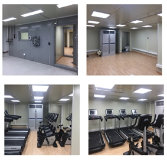
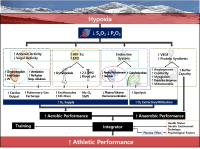
Purpose The purpose of this study is to emphasize the need for the establish and the use of altitude training center via examining exercise training method in natural or artificial altitude environment that is applied to various elite athletes in various advanced countries to maximize exercise performance and its effectiveness. Results Altitude training in natural or artificial altitude environment enhances aerobic and anaerobic exercise performance baesd on the hematological and nonhematological adaptations to hypoxic conditions. These altitude training methods can be classified into living high training high (LHTH), living high training low (LHTL), and living low training high (LLTH). LHTH (i.e., developed since the 1968 Mexico Olympics) and LHTL (i.e., developed in the 1990s by Levine and Stray-Gundersen) improve exercise performance via hematologic changes through erythropoiesis such as increased hemoglobin mass and erythrocyte volume. On the other hand, LLTH (i.e., has been developed variously since the 2000s) is composed continuous hypoxic training (CHT), intermittent hypoxic training (IHT) and repeated sprint training in hypoxia (RSH), and the altitude environment is constructed using a vacuum pump and a nitrogen generator. In general, LLTH method dose not induce hematological change in a short time within 3 hours. However, CHT and IHT enhance aerobic exercise capacity by improved exercise economy, supply and utilization of blood to tissues, capillary and mitochondrial densities, and oxidative enzyme activity through various biochemical and structural changes in skeletal muscle and cardiac muscle. RSH enhances anaerobic power and repetitive sprint performance by improving glycolytic enzyme, glucose transport, and pH control. In Korea, however, there are almost no facilities for altitude training that is applied to enhance athletic performance in advanced sports countries and recognition of the need for altitude training is also very poor. Conclusions Therefore, it is very urgent to develop altitude training for maximizing athletic performance in Korea and a lot of support and efforts are needed from the government and local governments.