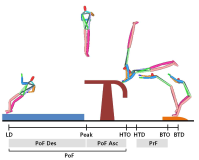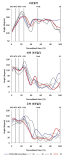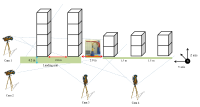
Purpose The purpose of the study was to perform a comparative analysis of the YANG Hak Seon technique carried out by "K" athlete with the kinematical data of "Y" athlete and propose a method to improve the YANG Hak Seon technique of "K" athlete. Method The subject recruited for the study was a male athlete from Korean national team (Age: 21, height: 1.65 m, body weight: 59.6 kg, and career: 11 years). Four high - speed cameras were used to analyze the 3D motion of the YANG Hak Seon technique performed by "K" athlete. The variables selected for analysis were the velocity of COM, displacement of COM, the rotational & torsional angle of the trunk and rotational & torsional angular velocity of the trunk. The results obtained were compared to the preexisting data of the "Y" athlete (data set from the published research). Results Firstly, the horizontal displacement of the YANG Hak Seon technique of the "K" athlete was observed to be shorter along with lower vertical displacement during landing compared to “Y” athlete. In addition, the overall horizontal velocity was low and vertical velocity was not generated which rises during the BC (board contact) phase. Although the rotational angular velocity of the trunk was lower during the BC, HC (horse contact) phase and LD (landing) phase, torsional angular velocity was higher during the LD. Conclusion In order to improve the completeness of the YANG Hak Seon technique of the K player, it is necessary to enter with a fast and low posture on the footplate during the initial phase. In the BC phase, it is essential to raise the COM simultaneously while landing on the footplate and increase the rotational angular velocity of the trunk.
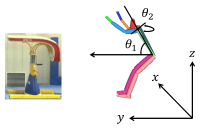

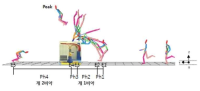
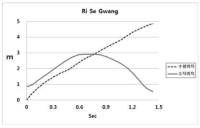
The aim of this study was to acquire essential information regarding Ri Se Gwang motion(element group Ⅱ, difficulty 6.4 point, double Tsukahara with tucked 1/1 twist), which Ri Se Gwang of North Korea performed during the final vault event of artistic gymnastic at Incheon Asian Game 2014, by analyzing motional characteristics. Firstly, Ri Se Gwang technique had second jump airborne time of 1.07 seconds and airborne height of 2.91m, which have great influences on the success of technique while having horizontal and vertical velocity of 2.73 m/s and 3.87 m/s, respectively, at the takeoff. These were sufficient jump motion for successful accomplishment of the technique however flight pattern was somewhat small which was mainly oriented vertically when compared to previous studies of Yeo and YANG Hak Seon 2 techniques. Secondly, blocking angle of vault contact was small at 9 degrees while having very small takeoff angle of 79 degrees. However, it had fast average trunk rotational velocity of 545 deg./s at the vault contact phase by rapidly bending trunk from the board takeoff until approaching the vault leading to achieve fast trunk rotational velocity of 452 deg./s after the take off in order to complete the airborne rotation successfully. Thirdly, the preparation phase of Ri Se Gwang technique had a distinct characteristics that the trunk was rapidly bent during the approach to the vault attempting aggressive blocking which leads to vertically oriented flight. It showed that this characteristic assists the motion of thigh snatch and the regulation of twist which strengthen airborne rotation for airborne rotational motion. And it also showed that sufficient landing and twist angles at the landing phase are possible with free rotational motion if the height of second jump reaches 3 m.



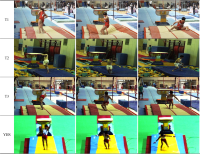
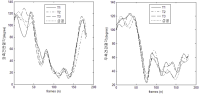
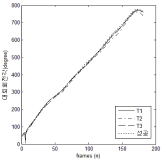
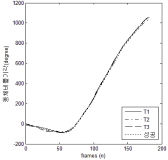
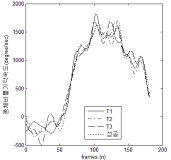
The research was a case study conducted in order to develop a new technique “YANG Hak Seon 2” for YHS athlete. A comparative kinematical three dimensional video analysis was performed with the use of high speed cameras. One successful trial and three of failure trials (T1: Falling backward while landing, T2: sitting reluctantly while landing, T3: Falling of sideways while landing). The result obtained from the study are as follows. Firstly when comparing the successful operation of the technique with failure trials, relatively higher landing angle was secured through increasing the thigh rotation and the body’s rotational velocity. Furthermore, despite increase in rotational velocity at twisting, stable landing was achieved through increasing the moment of inertia by spreading the left shoulder. Secondly, in case of failure trials while taking off the board, the thigh rotational angular velocity was comparatively less which ultimately affected the body position in the next phase of approach to the vault. Thus, due to the affected body position the athlete was not able to utilize the proper momentum of twist in positive direction Hence, it is considered that the velocity of center of mass might have also effected the operation not only the velocity while approaching the board.


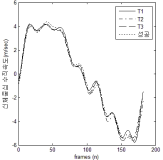





[Purpose] The purpose of this study was to compare Yeo 2 vault and YANG Hak Seon vault to verify the possibility of YANG Hak Seon vault. [Methods] The YANG Hak Seon vault and Yeo 2 vault performed by five Korean national gymnastic athletes, and the photographic images were collected using a high-speed camera and their kinematic characteristics were analyzed by 3D image analysis. [Results] The main variable of the post-flight phase S1, S4, and S2 were similar to YANG Hak Seon vault. S1 showed the largest at shoulder angle and the highest body center of mass at horse take-off. S4 showed the smallest shoulder angle at horse take-off, slow twisting at the post-flight ascending period, but faster femoral rotation during horse contact. S2 showed the slowest twist velocity in the ascending period of the post-flight and the smallest rotational distance and twist distance at the peak. S3 showed the slowest horse take-off velocity, the least time in the post-flight phase, and the hip joint was flexed at the peak. [Conclusions] S1 is required to increase the twist velocity by narrowing the shoulder angle during post-flight. S4 is required to strong push-up and an increase in the twisting velocity in the post-flight ascending period. S2 is required to shorten the horse contact time and increase the horse take-off angle through powerful femoral rotation after board take-off. S3 will have to get enough power from the preparation phase.