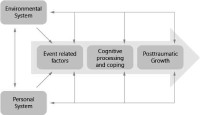
[Purpose] This study attempted to provide a literature review of the research on posttraumatic growth and to propose a revised model which mainly explain the relationships among serious leisure, posttraumatic growth, health, and happiness. The concept of psychological growth following a traumatic life event is most commonly referred to as posttraumatic growth in the literature and was first coined by Tedeschi and Calhoun (1995). It can be postulated that such experiences can lead to a richer appreciation for life, more compassion for others, closer relationships with others, better understanding of one's potentials and possibilities, and stronger religious faith. [Methods] The purposes of this study were achieved by (1) reviewing the posttraumatic growth and its relationship to serious leisure; (2) analyzing recent posttraumatic growth related models; and (3) proposing a revised posttraumatic growth model and a research agenda to further progress posttraumatic growth research. [Conclusions] Although there is an abundance of evidence for the existence of posttraumatic growth, its nature as well as benefits in relation to participation in serious leisure remain very partially understood. This study proposes a revised model for understanding the process of porsttraumatic growth in which serious leisure and cognitive processing play a significant role. Important implications of the relationships between serious leisure and posttraumatic growth are mainly discussed, alongside recommendations for future research.


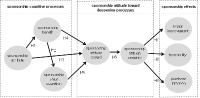
Purpose The purpose of this study was to examine the relationships among sponsorship attributes, sponsorship benefits, recognition of sponsorship value, sponsorship attitude, and sponsorship certainty through structural equation model. Methods Respondents were university students living in Seoul, Kyoungki-do, and choongchung-do. The present study was designed to identify the effect of title sport sponsorship by utilizing NH V-LEAGUE title sponsorship. By using convenience sampling method, total 400 questionnaires were distributed and gathered from samples, and among them 369 valid samples were used for further analyses. The data were recorded and analyzed using the IBM SPSSWIN Ver. 21.0 and AMOS 18.0. 18.0. Results First, sponsorship attributes had a positive influence on sponsorship benefits. Second, sponsorship benefits had a positive influence on sponsorship value recognition. Third, sponsorship attributes had no positive influence on sponsorship attitude. Fourth, sponsorship benefits had a positive influence on sponsorship attitude. Fifth, sponsorship value recognition had a positive influence on sponsorship attitude. Sixth, sponsorship attitude had a positive influence on sponsorship attitude certainty. Seventh, sponsorship certainty had a positive influence on sponsorship effects (image improvement, favorability, purchase intention).

Purpose This study was to examine the relationships among title sponsor's social inference(majority exposure, reliability, topicality, & social response), sponsor attitude formation(sponsor attitude, event sponsorship attitude, & communication attitude), and sponsorship effect (sponsor identification, attitudinal loyalty, and behavioral loyalty) in the professional volleyball contexts. Methods A survey was conducted by using college students (n=370) majoring in sport and physical education at four universities located in Chungcheong Province. The data were recorded and analyzed using the SPSSWIN Ver. 21.0 and AMOS 18.0 to analyze the structural equation model. Results First, the increased majority exposure had a significantly negative effect on sponsor attitude. Second, reliability was found to impact significantly on sponsor attitude. Third, topicality was found to impact positively and significantly on sponsor attitude. Fourth, social response did not show significant impact on sponsor attitude. Firth, sponsor attitude was found to significantly influence on event sponsorship attitude. Sixth, sponsor attitude had positive impact on communication attitude. Seventh, event sponsorship attitude was found to impact positively and significantly on sponsor identification. Eighth, communication attitude was found to impact positively and significantly on sponsor identification. Ninth, sponsor identification was found to impact positively and significantly on attitudinal loyalty. Tenth, sponsor identification was found to impact positively and significantly on behavioral loyalty. Finally, attitudinal loyalty was found to impact significantly and positively on behavioral loyalty.
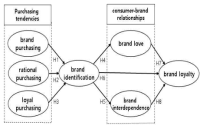
The purpose of this study was to investigate the relationships among purchasing tendencies, brand identification, consumer-brand relationships, and brand loyalty by analyzing structural equation model. A survey was conducted by using members(n=220) of 8 sport clubs located in Chungcheong Province. The data were recorded and analyzed using the SPSSWIN Ver. 21.0 and AMOS 18.0 to analyze the structural equation model. The findings of this study were as follows: First, brand purchasing had a significantly negative effect on brand identification. Second, rational purchasing was found to impact significantly on brand identification. Third, loyal purchasing did not show significant impact on brand identification. Firth, brand identification was found to significantly influence on brand love, brand interdependence, and brand loyalty. Fifth, brand love had no positive impact on brand loyalty. Finally, interdependence was found to impact significantly and positively on brand loyalty.
