Purpose The purpose of this study is to examine the location, rate, cause, and types of injuries according to the injured area by age and sports in female athletes. Methods The subject of the study was 426 female athletes who were registered as combat sports(Judo, Taekwondo, Fencing) athletes at the Korean Sports & Olympic Committee. We collected the data via online questionnaires, and conducted a frequency analysis using R statistics program. Results As a result, 51.4% of athletes experienced injuries in the past year, and the highest injury rate was shown in Taekwondo-University(0.43) during competition and Taekwondo-Professional(5.55) during training. The cause of injuries during competition was mainly due to 'as a result of me or the opponent's hittings, skills, or fouls' among internal factors, and 'recurrent injuries' among external factors. Among internal factors during training except for torso area and professional athletes, most of the injuries were also caused by ‘as a result of me or the opponent's hittings, skills, or fouls’ and ‘recurrent injuries’ among external factors. The frequency of injury was the highest in the lower extremity area across all age groups. The most frequently injured area, in the case of Judo, is skin-bleeding in the head, skin-bruise, muscle-inflammation, bone-fracture, spondylopathy(disc, stenosis, etc.) in the torso, muscle-inflammation in the upper extremity, ligament-sprain, rupture in the lower extremity. Taekwondo athletes had skin-bruise in the head, upper and lower extremities, and muscle-inflammation in the torso area, as the frequent injury cases, and Fencing athletes had all skin-bruise regardless of injuries. Conclusions The results of this study will be used to take measures for preventing injuries or to change training programs.
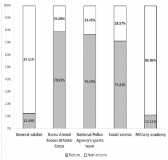
Purpose The purpose of this study is to identify the negative effects of long-term exercise (training and competition) suspension of male elite athletes due to compulsory military service on athletic performance, and to provide a basis for enhancing the importance of providing support systems and social conditions for maintaining athletic performance. Methods In this study, 17,418 male athletes aged 18 to 21 who were registered as athletes for the Korean Sports & Olympic Committee from 2003 to 2005 were enrolled. The athlete registration data includes information about the athlete's gender, age, sport and affiliation. According to the continuity of registration and belonging information, the compulsory military service type was classified into a manipulator. According to the form of Compulsory military service performed by male elite athletes, the return rate was confirmed and the career (year) was calculated. Results As a result of the survey, 12.49% of the athletes who served as general soldiers returned to the athletes after compulsory military service, showing a relatively low return rate compared to 78.91% of the Korea Armed Forces Athletic Corps, 76.55% of the National Police Agency's sports team, and 71.43% of the social service. Also, Athletes who served as general soldiers had a career of 2.46 years (± 1.94), while the Korea Armed Forces Athletic Corps was 10.21 years (± 3.58), the National Police Agency's sports team was 9.45 years (± 3.26), and the social service was 5.86 years (± 4.06), The exemption was 11.08 years (± 2.27), and the compulsory military service exception was 9.79 years (± 5.55). Conclusions Male elite athletes' decrease in athletic performance after compulsory military service is a natural result, as confirmed through the results of this study, and it is necessary to seek a support system between compulsory military service to maintain athletic performance.