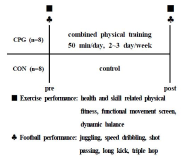
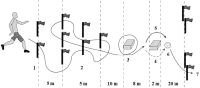
[Purpose] This study aimed to examine the effects of complex physical training on exercise and football performances in youth football players. [Methods] The subjects (n=16) were randomly assigned to either a complex physical training group (CPG, n=8) or a control group (CON, n=8). CPG was performed the complex physical training for 50 minute per day, and 2∼3 times per week, for 8 weeks. Exercise performance (health related physical fitness, skill related physical fitness, Y-balance and functional movement screen; FMS) and football performance (juggling, speed dribbling, shot passing, long kick and triple hop) were measured before and after 8 weeks complex physical training. [Results] Sit-up (p=0.002), sit and reach (p=0.040), 50-m run (p=0.031), side step (p=0.005), single-leg standing with eyes closed (p=0.040), plank (p=0.023), dominant composite score (p=0.002) and non-dominant composite score (p=0.005), deep squat (p=0.009), inline lunge (p=0.042), active straight leg-raise (p=0.015), rotary stability (p=0.049), total score(p=0.001), speed dribbling (p=0.030), dominant triple hop (p=0.001) and non-dominant triple hop (p=0.032) were statistical significant interactions between group and time. [Conclusion] Our findings indicate that complex physical training has beneficial effects on performance improvement of exercise and football in youth football players.
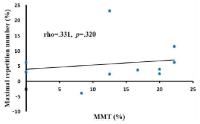
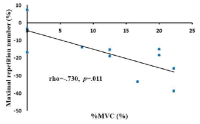
The purpose of this study was to determine whether maximum repetition number can be used as an indicator of strength imbalance. Eleven healthy, resistance-trained males were tested for one repetition maximum (1-RM) the chest-press exercise, and than manual muscle testing (MMT), two-arm at 80% of 1-RM and one-arm at 40% of 1-RM in the pectoralis major were measured for the maximum voluntary contraction (%MVC) and maximum number of repetitions during the chest press exercise. Exercise velocity was constantly 4 seconds (concentric: 2-s, eccentric: 2-s) per repetition. The changes in %MVC were significantly higher in non-dominant limb (NDL) compared with dominant limb (DL) pectoralis major during two-arm chest press (p < 0.01) and one-arm chest press exercise (p < 0.05). In contrast, the changes in MMT (p < 0.05) and maximum repetition number (p < 0.01) were significantly higher in DL compared with NDL during one-arm chest press exercise. There was no correlation between maximum repetition number and MMT (rho = 0.331, p = 0.320). However, maximum repetition number was significantly negative correlated with %MVC in two-arm chest press (rho = -0.730, p = 0.011). It is possible that maximum repetition number can be used as an indicator of strength imbalance.