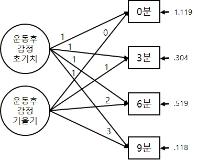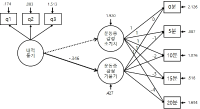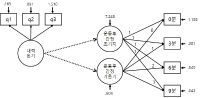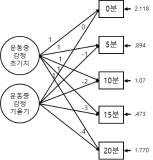
Recent research on exercise and affect has examined participants` affective changes during and after exercise with a longitudinal approach. With regard to this viewpoint, a theoretical model (Dual Mode model) has been presented to explain the different change of affect in an exercise setting and the model identified the impact of psychological factors on the affective changes. However, not only there is little empirical studies on the dual-mode model, but some relevant research has used an inappropriate statistical method (ANOVA), which cannot effectively explain the overall trends in affective change during and after exercise. Exiting research has a limitation to generalize the DM model examining only a certain gender such as active male or inactive female participants. Thus, the aim of present study was to investigate the effect of intrinsic motivation on affective change during and after exercise in participants who do not take part in regular exercise considering gender based difference. 51 inactive university students (M: 36, F: 15) responded a survey measuring intrinsic motivation for running activity and participated in moderate-intensity running exercise to examine affective change during exercise. Therefore, present study examined the influence of intrinsic motivation as a psychological variable on the trend of affective changes during and after exercise based on the dual mode model. Results from the latent curve model analysis revealed that there were decreasing trends of affect during exercise and the trends were individually different. Importantly, the decreasing trends were weaker in the participants with higher intrinsic motivation[FL=-.34, p=.000]. Additionally, participants` affective responses were positively changed after the exercise in general, but the changes were not influenced by intrinsic motivation. Therefore, the decreasing trend of affective change during exercise was weaker in the participants with higher intrinsic motivation, and the positive change in affect after exercise was not influenced by intrinsic motivation.