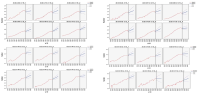
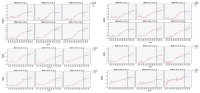
The present study has been carried out with a purpose of a long term estimation for the body size and BMI (Body Mass Index) of Korean children and youth using ARIMA, a time series model. In order to select an estimation model for the optimum time series, among the time series analysis method of SPSS22.0 statistic programs, a multivariate ARIMA (p,d,q) model has been selected that has an input series (physical education facility, time spent for physical education, animal source foods, GDP deflator, animal source food intake ratio), using annual average data of height, weight, and BMI data from 1965 to 2015. Among the several optimal measurements in ARIMA model with estimation variables, an optimal RMSE-based model (RMSE: Root Mean Square Error) has been selected. Using this model, the estimation model and estimated values of children’s height, weight, and BMI have been suggested for each age group. The results are as the following. The trend estimation of height follows a logistic curve, with both male and female groups showing increasing trends. The weight has a trend of increasing ratio higher than height. BMI also shows a trend curve similar to weight. The estimation model has been mostly ARIMA(0,1,0). In particular, the average BMI has been estimated as 22-23 for male students in 6th, 8th, 9th, 11th and 12th grade in 2030. This indicates the recent increasing obesity as children and youth occupy most of daily time for play culture that is far from physical activities, such as computer games, smartphone games, and video games at home.