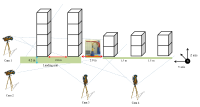
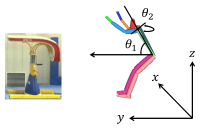
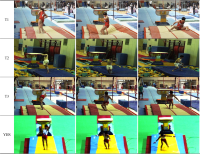
Purpose The purpose of the study was to perform a comparative analysis of the YANG Hak Seon technique carried out by "K" athlete with the kinematical data of "Y" athlete and propose a method to improve the YANG Hak Seon technique of "K" athlete. Method The subject recruited for the study was a male athlete from Korean national team (Age: 21, height: 1.65 m, body weight: 59.6 kg, and career: 11 years). Four high - speed cameras were used to analyze the 3D motion of the YANG Hak Seon technique performed by "K" athlete. The variables selected for analysis were the velocity of COM, displacement of COM, the rotational & torsional angle of the trunk and rotational & torsional angular velocity of the trunk. The results obtained were compared to the preexisting data of the "Y" athlete (data set from the published research). Results Firstly, the horizontal displacement of the YANG Hak Seon technique of the "K" athlete was observed to be shorter along with lower vertical displacement during landing compared to “Y” athlete. In addition, the overall horizontal velocity was low and vertical velocity was not generated which rises during the BC (board contact) phase. Although the rotational angular velocity of the trunk was lower during the BC, HC (horse contact) phase and LD (landing) phase, torsional angular velocity was higher during the LD. Conclusion In order to improve the completeness of the YANG Hak Seon technique of the K player, it is necessary to enter with a fast and low posture on the footplate during the initial phase. In the BC phase, it is essential to raise the COM simultaneously while landing on the footplate and increase the rotational angular velocity of the trunk.
The purpose of this research is to provide the information about sports injury by surveying and analyzing a result, and to lead analytic and scientific training among the subjects being elite summer sport athletes. All sports injuries are recorded on injury report form and the following results were obtained. In Cycle sport, the prevalence of injuries of the low back, knees were highest. and In Table tennis sport, the prevalence of injuries of the ankle was highest due to the chronic fatigue. The prevalence of injuries of the shoulder, low back were highest due to the overuse of joints. In Badminton sport, the prevalence of injuries of low back, knees, ankles were highest by overtraining. In Gymnastics, the prevalence of injuries of the low back, knees, ankles were highest. In Archery sport, there is a lot of injuries to the shoulder and neck. In Weight lifting sport, the prevalence of injuries of the low back, knees, and ankles were highest. In Golf sport, the prevalence of injuries of knees, low back were highest. In Hockey sport, the prevalence of injuries of ankles, knees, low back were highest. In Boxing sport, the prevalence of injuries of hands, shoulder, the low back were highest, In Judo sport, there are overall damage occurred in parts of the whole body, but the prevalence of injuries of ankles, knees, low back were highest. In Fencing sport, the prevalence of injuries of the low back, knees were highest. In Wrestling sport, although there is a difference slightly depending on freestyle and Greco-Roman, but the prevalence of injuries of knees, ankles, low back were highest. In Handball sport, the prevalence of injuries of ankles, knees were highest. In Taekwondo, the prevalence of injuries of ankles, knees, feet were highest.
