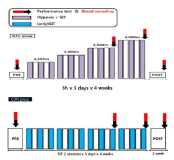
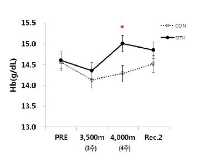
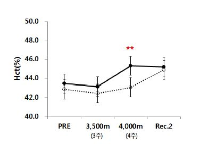
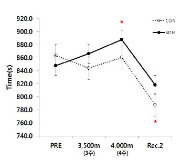
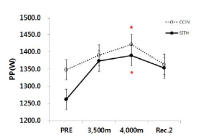
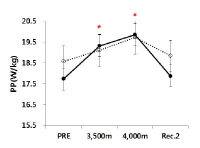
In this study, hypoxic exposure and training with regard to the current progress during the various models 'live and/or sleep high: train high' by way of 4 weeks in elite level tennis players. The experimental group which SITH(SIT with hypoxic) a 2,500m-4,000m to the graded elevation every 500m increased by the week five times a day, two times four weeks treated to a SIT (sprint interval training) and three hours of exposure in hypoxic chamber(simulated normobaric hypoxic). The CON(control) was conducted same period and methods without exposure to hypoxia that a SIT at sea level. As a results, the haematological variables were Hb and Hct compared Pre with the treatment at the end of 4,000 m(at 4 weeks) has been shown to significantly increased in both groups respectively(p<.05, p<.01; vs. Pre). Aerobic exercise capacity related variables that Time was SITH has been shown to significantly increased at 4,000 m(p<.05; vs. Pre). Also, VO2max was SITH has been showed increased in the same period a tendency(p=.072). Anaerobic exercise capacity related variables that PP(W) was both groups increased significantly at 4,000 m(p<.05; vs. Pre), and PP(W/kg) was CON group has been showed increased in the same altitude a tendency, whereas SITH group has been showed increased at 3,500m and 4,000m respectively(p<.05; vs. Pre). Therefore, this study was unlike previous studies with similar positive results as a follow-up study will be contribute to the attainment of a higher value.
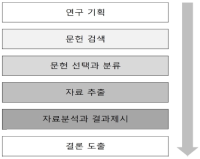
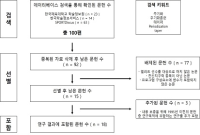
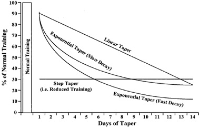
Purpose The aim of this study was to provide athletes and coaches on informations and benefits of a taper through evidence-based scientific studies and literatures in order to optimize an athlete’s top performance for the major competition. Methods Studies and literatures search was conducted using the databases RISS, KISS, SPORTDiscuss. Key words searched: taper AND(competition, OR performance, OR training, OR training). This study were eventually cited by 22 articles for results of this in total 100 articles. Results The training load is remarkably reduced during a taper. With a reduced training load, training intensity should be maintained during the taper. The training load reductions during the taper should be programmed with reducing training volume at 41% to 60% of pretaper training. The reduction of training frequency during a taper means that affect moderately trained athletes and highly trained subjects differently, reducing 30% to 50% of pretaper training and maintaining training frequencies, respectively. Detraining the duration of a taper is not easy. Most athletes is beneficial from a 2-week shorter or longer tapers, depending on their individual profiles of fitness loss, fatigue dissipation, and anxiety. The manipulations of this training program variables usually affect for most athletes and maximal performance gains. Conclusion Training intensity should be maintained during the taper, training volume reductions should be programmed at 41% to 60% of pretaper training. The reduction of training frequency could be reduced 30% to 50% of pretaper training, and most athletes is beneficial from a 2-week shorter or longer tapers. Future researches should be conducted the practical & effectual differences in individual and teamed-based sports after a taper procedure.