
Purpose The purpose of this study is to calculate the ranking of vault players in artistic gymnastics by individual and by country using the PageRank algorithm. The purpose of this study is to provide basic data that can be used in gymnastics events by comparing the performances of historical vault players with those of previous Olympic competitions. Methods The data collected for this purpose is a score of 117 vault players based on the results of the Olympic final event published in the International Gymnastics Federation (FIG). For data analysis, PegeRnak algorithm was used for calculating the ranking of vault players using MS-Excel and NetMiner. Results The results are as follows that. First, the PageRank algorithm is possible to calculate for historical vault players' rankings. Specifically, the ranking of vault players for historical Olympic calculated by PageRank ranked as Gervasio Deferr from Spain (ESP) at 1st, Alexei Nemov from Russia (RUS) at 2nd, and Klaus Koste from Germany (GDR) at 3rd. Second, Network of vault players' ranking is separated by each generation of Olympic games. Conclusions As a conclusions, it is possible to calculate national ranking of vault games of gymnastics by using PageRank algorithm.


Purpose The purpose of this study is to introduce the basic concepts and procedures for topic modeling and to explain topic modeling to news articles about dementia-related physical activities. And it is also to discuss the possibility of using topic Modeling in the field of physical education. Methods In this study, the LDA algorithm of topic modeling is explained and the analysis procedure is summarized step by step by text preprocessing, text formatting, and topic number determination. The application cases were selected from 274 news articles about dementia-related physical activities reported in 13 major daily newspapers from 2000 to 2018. Results When the number of topics is 3, the Coherence Score figure is the highest. Topic 1 is about welfare services for dementia patients, Topic 2 is about prevention of dementia, and Topic 3 is about dementia research. The ratio by each subject is Topic 2 (46.0%), Topic 3 (33.2%) and Topic 1 (20.8%) in order of high ratio. Conclusion Topic modeling is an effective methodology to extract potential information excluding subjectivity of researchers. It is expected to be used when searching for information in massive texts in the field of physical education.



Purpose The purpose of this study was to explore the optimal model for winning medal on vault event of men's gymnastics. Specifically, decision tree analysis was used to explore, first, for the optimal conditions for qualifying top 8th player that have high possibility into final round, and second, for the optimal model for obtaining the medal of the vault event. Methods Data were collected for five official competitions (Olympics, Asian games, and International championship, etc.) organized by the Federation of International Gymnastics (FIG) from 2013 to 2016. In this study, the data of 626 vault players were collected. Also all of these players performed 921 vault skills for qualifying round or final round. Five predictor variables for estimating for qualifying into the final round and for obtaining the medal of the vault event were selected; nationality, difficulty score, acting score, additional penalty score, final score. Results The results is as follows. Overall, it was confirmed that the optimal model for entering into the final round was the difficulty score of vault event. The optimal model for entering into the final round estimates 81.2% when condition would be the 5.6 or higher of difficulty score and 8.6 or higher of the acting score. The optimal model for winning medals was 86.7%, which means that when condition would be the 6.0 or higher of difficulty score and no additional penalty score. Conclusions This models can be used as a basic data for establishing a strategy for medal acquisition of vault event of gymnastics.


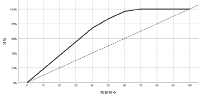
PURPOSE This study sought to establish obesity diagnosis criteria by using the Body Volume Index (BVI) by body part extracted through 3D BodyScanner. METHODS The body fat percentage was measured using Dual Energy X-ray Absorptiometer (DEXA) for 225 participants (male = 119, female = 106), and BVI for eight body parts was measured using 3D BodyScanner. Independent t-test and Receiver Operating Characteristic (ROC) analysis were conducted. ROC analysis calculated the Area Under the Curve (AUC), and the optimal cut-point by Youden's J index. Sensitivity, Specificity, Accuracy, Balanced Classification Rate (BCR), and F1-score (harmonic mean of recall and precision) values were calculated to verify the validity of the optimal cut-point. RESULTS A statistically significant difference was observed in BVI by body part according to whether obesity was present for both men and women, and the obese group higher than the normal group. The optimal cut-point for each body part to diagnose obesity was 7.96 for shoulder, 9.79 for chest, 7.15 for upper abdominal, 7.71 for lower abdominal, 14.89 for total abdominal, 9.79 for thigh, 5.70 for calf, and 74.96 for total body volume in men. In case of women, this was 6.04 for shoulder, 9.82 for chest, 4.96 for upper abdominal, 6.23 for lower abdominal, 11.63 for total abdominal, 8.88 for thigh, 4.05 for calf, and 58.15 for total body volume, and the accuracy was 0.6~0.9. CONCLUSIONS BVI is a useful indicator for diagnosing obesity. However, this can be applicable only to Asian adults since there may be differences depending on race or age.
