
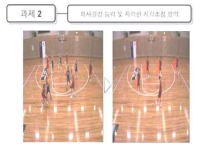
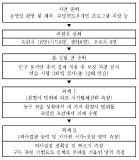
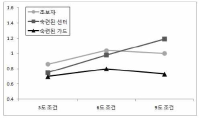
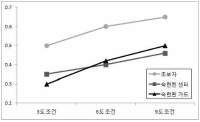
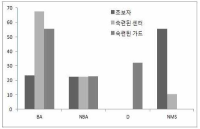
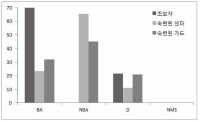
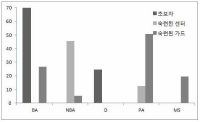
The purpose of this research was to investigate the difference in decision making and perceived eye-focus location on peripheral vision and attacker's expertise in basketball tactical game. A total of twenty four subjects who were expert guard players (n=8), expert basketball center players (n=8), and novices (n=8), participated in this experiment. All subjects participated two tasks. The first task was to anticipate the attack direction after viewing a sequence of basketball tactic film. These films simulated three situations including offensive patterns. The three situations were consist of 3, 6, 9 degree peripheral vision. The second task was to express the level of confidence on their anticipation and to verbalize the perceived visual cues immediately after responding. For this research, an Eyelink eye movement system, an equipment for measuring anticipating, basketball tactic film were used. The variables on anticipation of attack direction were speed, accuracy, and the level of confidence. The acquiring process of advanced visual cues was examined through analyzing visual search strategies and perceived eye-focus location. In order to examine the difference in visual search, in decision making, and in perceived eye-focus locations as a function of expertise, data were analyzed through descriptive statistics, two-way ANOVA, and two-way MANOVA. This research had the following results. First, there was a significant difference on the search rate among the three groups. But, on the other hand, expert guard and center exhibited more fixations of shorter duration than the novices in the 6 and 9 degree condition. Second, results from the ratio of fixation time allotted to areas in the 3 degree condition revealed that experts spent more time fixating the ball-attacker(BA) than novices. The results from the ratio of fixation time allotted to areas in the 6 and 9 degree condition revealed that expert guard and center spent more time fixating the non-ball attacker(NBA) than novices. Expert guard also fixated longer on the pass attacker(PA) and meaning space(MS) than novices. Finally, experts paid attention to two or three locations simultaneously, whereas novices did to only one location such as the ball, attacker, defender, non-meaning space in all condition.


As an attempt to think about the popularization of Korean sport history, this paper discusses three main things. First, it will be introduced what public/popular history is, how it has been developed, and why it is important to history as an academic discipline. Second, it will be summarized how sport historian embraced public/popular history into their practices in terms of what theoretical, critical, and methodological aspects they have focused. Third, I will discus why public/popular history is useful in the ways in which Korean sport history envisions its popularization in Korean society. To be more specific, I highlight two ideas: an insight for understanding sport history as a process and sport historiansʼ role of critic. Based upon these two, I will argue that Korean sport historians might need to actively embrace practices of public/popular history into their studies of the Korean sporting past.
The purpose of this paper is to map how sport sociologists and sport historians have engaged in the study of race and/in sport. Focusing on scholars with two communities of the North American Society for Sport Sociology & Sport History, it investigates themes, historical/sociological philosophy, theoretical/methodological issues that underpin their works. To be more specific, mainly four types of research are detailed: 1) popular narratives that mostly celebrate black athletes’ success in sport, 2) so-called the early academic works that highlight the positive role of sport in advancing the issue of race in relation to social justice, unification, equality, and so on, 3) a group of researches informed by the positivism, which attempt to discover, investigate, identify racially problematic phenomena, incidents, policies, or incidents and explain why they happen, what makes them problematic, and how to solve such matters, and 4) critical paradigm that orients cultural studies based researches that attempt to explore the relationship between sport and race with focus on interpretive, theoretical, and reflective approaches. In conclusion, it is discussed why I pay attention to the critical paradigm, what it’s emergence means to the sporting academy, and in what ways we can embrace it into the Korean sporting academy.
